

The promise of escaping the 9-to-5 grind is louder than ever. Scroll through Instagram or TikTok, and you are bombarded with “laptop lifestyle” gurus promising financial independence through passive income. Usually, these opportunities boil down to two distinct business models: Affiliate Marketing and Multi-Level Marketing (MLM).
To the untrained eye, they look identical: You recommend a product, someone buys it, and you get paid.
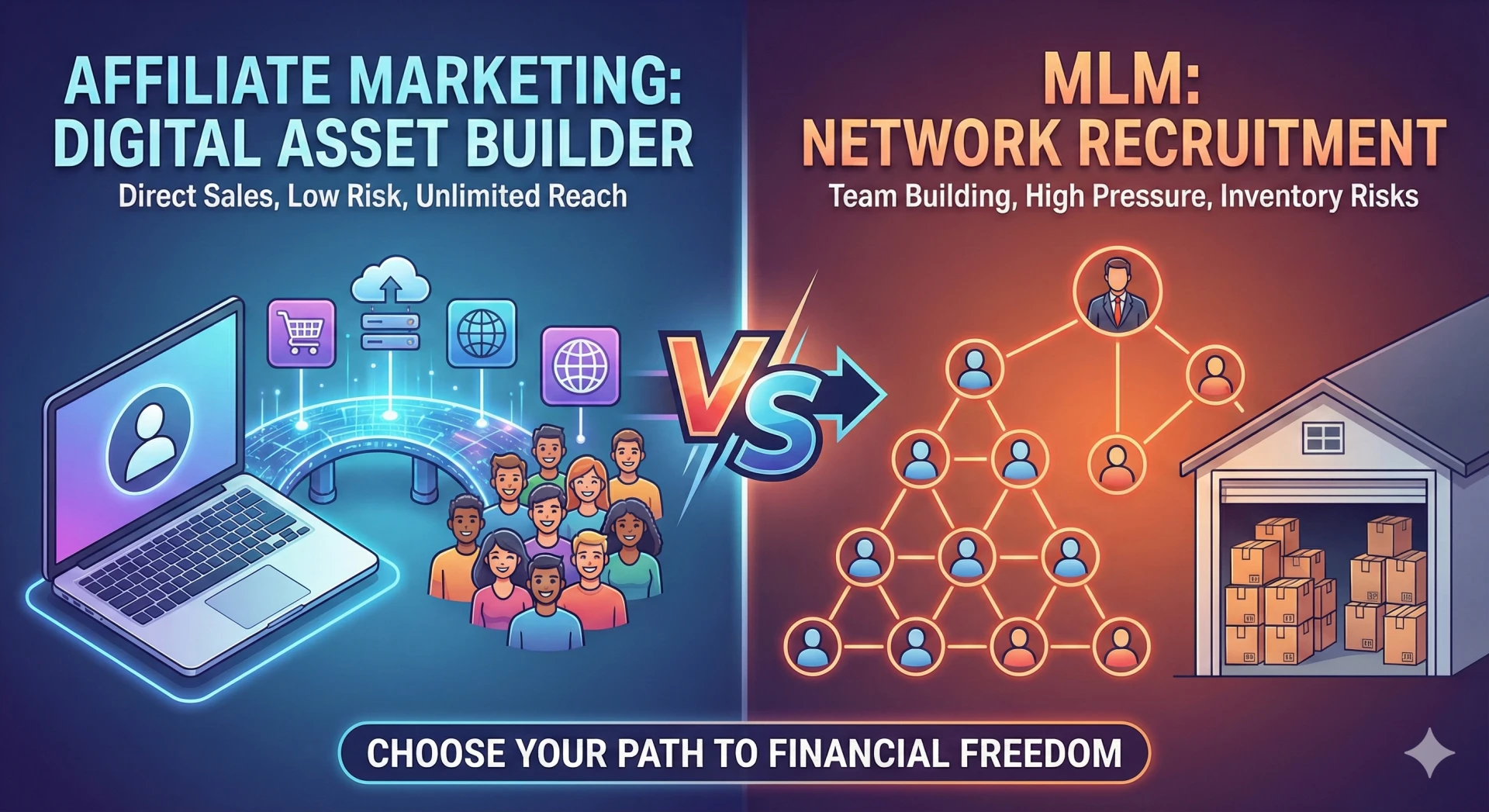
But looking closer, you will find two completely different worlds. One focuses on building digital assets and scalable traffic; the other focuses on recruitment and network management. One offers autonomy; the other offers community but often at a steep price.
If you are trying to decide between starting an affiliate blog or joining a network marketing team, you need the cold, hard facts. This guide digs deep into the mechanics, the money, the risks, and the reality of Affiliate Marketing vs. MLM (Multi-Level Marketing).
The Core Definitions: Clearing the Confusion
Before analyzing the profitability, let’s strip away the jargon and define what these models actually are.
What is Affiliate Marketing?
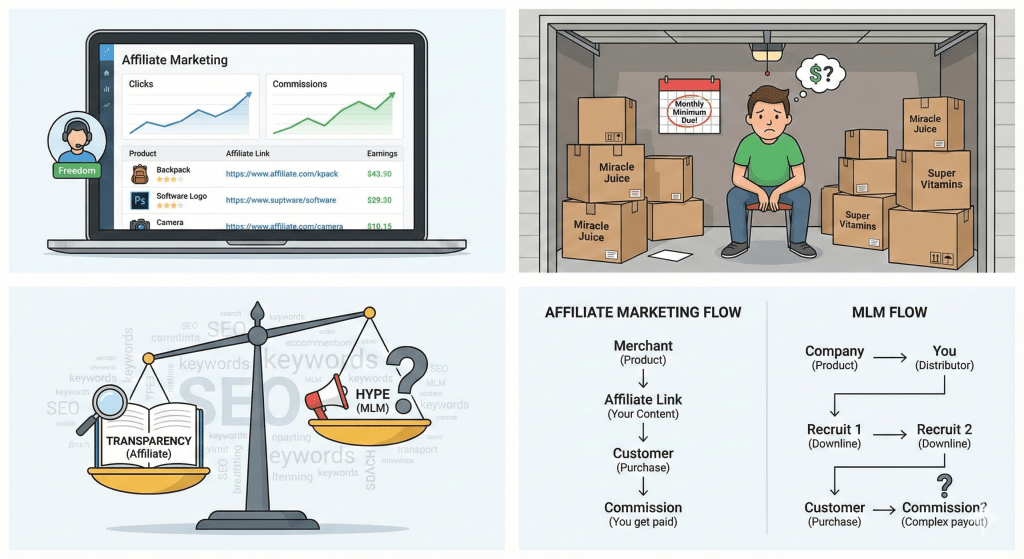
Affiliate marketing is a performance-based marketing system. You (the publisher/affiliate) partner with a business (the merchant) to promote their products. You use a unique tracking link (affiliate link). When a consumer clicks your link and makes a purchase, you earn a commission.
The Key Characteristics:
- Single-Level Payout: You generally get paid only on your direct sales.
- No Recruitment: You do not need to hire people under you to make money.
- Inventory-Free: You do not hold stock, handle shipping, or deal with customer service.
- Platform Independence: You can promote products from Amazon, software companies, or niche brands simultaneously.
The “Vibe”: Think of yourself as a freelance digital recommender. You build a bridge between a problem (the customer’s need) and a solution (the product).
What is Multi-Level Marketing (MLM)?
Multi-Level Marketing, also known as Network Marketing or Direct Sales, is a hierarchical business model. You sign up as a distributor for a specific company.
The Key Characteristics:
- Dual Revenue Streams: You earn from selling the product and from the sales made by people you recruit (your “downline”).
- Recruitment Heavy: To reach high income levels, you must recruit, train, and manage a team.
- Brand Exclusivity: You typically represent one specific company (e.g., Amway, Herbalife, Mary Kay).
- Pay-to-Play: Often requires buying a “starter kit” or maintaining a monthly personal volume (PV) of sales to qualify for commissions.
The “Vibe”: Think of yourself as a micro-franchise owner who is also a team manager and recruiter.
At a Glance: Affiliate Marketing vs. MLM Comparison Table
For the quick decision-makers, here is how the two stack up against critical business metrics.
| Feature | Affiliate Marketing | Multi-Level Marketing (MLM) |
| Primary Focus | Driving traffic and sales to products. | Recruiting new distributors and team building. |
| Cost to Start | Low (Domain/Hosting ~$50-$100). | Moderate to High (Starter kits + Monthly minimums). |
| Barrier to Entry | Very Low. Anyone can join. | Low, but requires “sponsorship” usually. |
| Income Source | Direct commissions on sales. | Direct sales + overrides on team sales. |
| Control | High. You own your website/email list. | Low. You play by the company’s strict rules. |
| Inventory | None. | Sometimes required (garage qualification). |
| Scalability | High (Digital scale). | Limited (Time scale/Human management). |
| Risk | Low financial risk. | High financial risk (inventory/monthly fees). |
| Freedom | Location and schedule independent. | Often requires meetings, calls, and events. |
Deep Dive: The Mechanics of Affiliate Marketing
Affiliate marketing has exploded, with 81% of brands now utilizing it. Why? Because it is efficient. It is pure meritocracy.
The Pros: Why It’s the “Asset Builder’s” Choice
1. Ultimate Freedom and Anonymity
You don’t have to harass your friends and family to buy vitamins. In fact, you never have to speak to a customer if you don’t want to. You can build a blog, a YouTube channel, or a niche site that generates traffic while you sleep. You are building a digital asset that has value independent of your time.
2. Zero Production or Fulfillment Headaches
As an affiliate, your job ends the moment the customer clicks the link. The merchant handles:
- Payment processing.
- Shipping and logistics.
- Returns and refunds.
- Customer support.
3. Unlimited Product Selection
In MLM, you sell what the company makes. If they change the formula and the product becomes terrible, you are stuck. In affiliate marketing, if a product quality drops, you simply switch your link to a competitor’s product. You are loyal to your audience, not a corporation.
4. High SEO and Long-Tail Keyword Potential
Affiliate marketing thrives on search engine optimization (SEO). You can target specific queries like “best camping tent for tall people” or “CRM software for small dentists.” These are high-intent searches. People are ready to buy; they just need guidance. This is “pull marketing” (attracting interested people) vs. “push marketing” (convincing uninterested people).
The Cons: The Challenges of the Affiliate World
- Traffic Dependency: You are invisible without traffic. You must learn SEO, paid ads, or social media algorithms.
- Commission Lag: While some modern programs offer fast payouts, many operate on Net-30 or Net-60 terms to account for refund periods.
- Competition: Popular niches (weight loss, finance) are crowded with major publishers.
Deep Dive: The Mechanics of Multi-Level Marketing (MLM)
MLM is a massive industry, generating billions globally, particularly in wellness and beauty. It relies on the power of personal recommendation and social networks.
The Pros: The Power of Community
1. Structured Training and Mentorship
If you have zero business experience, MLMs provide a “business in a box.” You get sales scripts, marketing materials, and an “upline” (mentor) who is financially incentivized to help you succeed. For extroverts who love coaching, this environment can be stimulating.
2. Residual Income via Leverage
The allure of MLM is the “downline.” If you recruit a superstar seller, you earn a percentage of their sales volume forever. Theoretically, if you build a massive team, you can stop working and watch the checks roll in (though this is statistically rare).
3. Personal Development
MLMs are famous for their focus on mindset, public speaking, and leadership. Many participants credit MLM for helping them break out of their shells and gain confidence, even if they didn’t become millionaires.
The Cons: The “Dark Side” of Network Marketing
1. The “Pyramid” Stigma and Legal Gray Areas
While legitimate MLMs are legal, they often skirt the line of Pyramid Schemes. The FTC distinguishes them by one main factor: Are you paid primarily for selling products to consumers, or for recruiting new distributors? If the money comes from recruitment, it’s a scheme. This stigma makes marketing difficult; you often have to overcome skepticism before you even pitch the product.
2. The “Pay-to-Play” Trap
Most MLMs have a “Personal Volume” (PV) requirement. To qualify for your commission check, you might have to sell (or buy) $100-$500 worth of product monthly. If you have a slow month, you might end up buying products yourself just to stay active. This is how many distributors end up with a garage full of unsold inventory.
3. Social Strain
“Hey hun! Long time no see!”
We have all received that message. Monetizing your friendships can strain relationships. When every dinner party becomes a sales pitch, you lose social capital fast.
Follow the Money: Payouts, ROI, and Speed
When choosing a business model, you aren’t doing it for charity. You are doing it for profit. Let’s look at the financial reality of Affiliate Marketing vs. MLM.
1. Earning Potential and Success Rates
- MLM Stats: According to the FTC and various consumer awareness studies, 99% of MLM participants lose money or break even. The top 1% earn the vast majority of the wealth. The median income for many distributors is less than $1,000 annually.
- Affiliate Stats: Affiliate marketing is tough, but the bell curve is more forgiving. While many beginners quit, a dedicated affiliate marketer can scale from $0 to $1,000/month within 6-12 months through consistent content creation. Super affiliates easily earn six or seven figures without recruiting a soul.
2. Payout Speed and Frequency
In the digital age, cash flow is king.
- Affiliate Payouts: Traditionally monthly (Net-30). However, modern SaaS tools and platforms are moving toward weekly or even instant payouts to keep affiliates motivated.
- MLM Payouts: Usually monthly. The calculation is complex, factoring in rank advancements, leg balancing, and breakaways. It can take weeks to understand why you were paid the amount you were paid.
3. Cost of Customer Acquisition (CAC)
- MLM: Your cost is largely time (meetings, calls, parties) and social capital. However, expenses for conferences, training materials, and travel can add up to thousands per year.
- Affiliate: Your cost is content production or ad spend. You can start for free using organic social media (TikTok/YouTube) or free blogging platforms (Medium/LinkedIn).
The “Control” Factor: Who Owns Your Business?
This is perhaps the most critical section of this blog.
In MLM, you do not own the business. You are a 1099 independent contractor for a corporation.
- If the company goes bust, your income hits zero.
- If they change the compensation plan (which happens often), your income can drop 50% overnight.
- You cannot sell your “position” or downline easily on the open market.
In Affiliate Marketing, you own the asset.
- If you build a website with 100,000 monthly visitors, that is an asset. You can sell that website on a marketplace like Empire Flippers or Flippa for 30x-40x your monthly profit.
- You own your email list. If Amazon Associates shuts down, you send an email to your list promoting a different partner. You pivot. You survive.
The Verdict on Control: Affiliate marketing gives you equity value; MLM gives you cash flow (maybe), but rarely equity.
Can They Coexist? The Hybrid Model
Is it possible to take the best of both worlds? Absolutely.
Smart marketers are realizing that the mechanisms of MLM (tiered commissions) can be powerful without the baggage of MLM (mandatory recruitment).
Tiered Affiliate Programs
Many software companies (SaaS) now offer 2-tier affiliate programs.
- Tier 1: You sell the software and get 30%.
- Tier 2: You refer another affiliate. That affiliate sells the software. They get 30%, and you get a 5% “override” for referring the partner.
Why this works: It rewards you for bringing in talent, but it stops at two levels. It doesn’t spiral into an unsustainable pyramid. It incentivizes mentorship without creating a predatory environment.
If you are a merchant running an online store, using tools like AffiliateWP allows you to set up these tiered structures ethically, boosting your reach without turning your brand into a “scheme.”
Trust and SEO: The Hidden Battleground
For those of you looking to build a long-term brand, consider the impact of SEO and Trust.
SEO (Search Engine Optimization):
- Affiliate: Content-friendly. Google loves high-quality reviews, comparisons (“Product A vs Product B”), and tutorials. This content ranks well and brings free traffic.
- MLM: Google often penalizes “thin” content sites that just replicate MLM corporate pages. Furthermore, because thousands of distributors use the exact same copy provided by the headquarters, you face “duplicate content” issues, making it nearly impossible to rank.
Brand Trust:
- Affiliate: If you are transparent and disclose your links (e.g., “As an Amazon Associate, I earn…”), readers appreciate the honesty. If you review a product and say, “This feature sucks, don’t buy it,” you gain immense trust.
- MLM: It is hard to be objective when you are contractually obligated to be a cheerleader for one specific brand. If you only review your own company’s products positively, your audience will eventually tune you out.
Summary: Which Door Should You Walk Through?
You are standing in a hallway with two doors. Which one leads to the life you want?
Choose Multi-Level Marketing (MLM) If:
- You are a high-energy Extrovert: You love parties, phone calls, and motivating people.
- You need a “Family”: You are looking for a community and are willing to pay for entry.
- You love a specific product: You genuinely use the product and would recommend it even if you weren’t getting paid.
- You are thick-skinned: You can handle 90% rejection rates and criticism from skeptics.
Choose Affiliate Marketing If:
- You value Freedom and Autonomy: You want to work from a laptop, anywhere, without answering to an upline.
- You are an Introvert or Creator: You prefer writing, video editing, or SEO over cold calling.
- You want to build an Asset: You want to build a brand or website that you can eventually sell.
- You hate selling: You prefer recommending and helping rather than hard closing.
- You have little money to start: You want to bootstrap a business with minimal financial risk.
FAQ: Frequently Asked Questions
Q: Is Affiliate Marketing a Pyramid Scheme?
A: No. Affiliate marketing is single-level. You are paid only for the sales you generate. There is no money exchanged for recruitment, which is the hallmark of a pyramid scheme.
Q: Can I do both MLM and Affiliate Marketing?
A: Yes, but be careful. Most MLM contracts have “non-compete” clauses that prevent you from promoting other products. Affiliate marketing usually has no such restrictions.
Q: Which one is more profitable in 2026?
A: In terms of average earnings and scalability, affiliate marketing is generally more profitable for the average individual. It allows for high-ticket commissions (selling software or courses for $1,000+ commissions) which is rare in MLM retail sales.
Q: How do I recruit affiliates for my own business?
A: If you own a business, you can set up an affiliate program using tools like Easy Affiliate or AffiliateWP. You recruit partners by offering competitive commissions, fast payouts, and high-quality marketing assets (banners, swipe copy) that make their job easy.
Q: What is “High Ticket” Affiliate Marketing?
A: This involves promoting products with high value, such as luxury travel, enterprise software, or gold IRAs, where a single sale can net you $500 to $5,000. This is a popular strategy to reach high income with lower sales volume.
Conclusion
The battle between Affiliate Marketing vs. MLM isn’t just about business models; it’s about lifestyle design.
MLM offers a path paved with community and structured steps, but it comes with the heavy baggage of recruitment pressure, monthly fees, and a statistical ceiling that few break through.
Affiliate Marketing offers a lonelier but freer road. It is a path of digital asset creation, low risk, and unlimited scalability. It rewards value creation over recruitment. For the modern entrepreneur looking to escape the rat race without joining a “cult-like” environment, affiliate marketing is the clear winner.
The internet has democratized wealth. You no longer need a gatekeeper, a starter kit, or an upline to grant you permission to earn. You just need a laptop, a connection, and the willingness to learn.
Are you ready to stop recruiting and start building?