


One of the biggest challenges startups face today is acquiring customers.
Whether you’re a founder or a marketer, the pressure to grow without overspending your startup is constant.
Traditional advertising methods like TV, billboards, or digital ads often require a significant upfront investment, that too without guaranteed results—something most startups can’t afford.
Well, no surprise to this, startups are turning to low-cost and effective marketing strategies like social media, email marketing, and referral systems. To help your startup move beyond its early stages and grow, you need to implement the right marketing strategy.
In this scenario, Affiliate marketing for startups could be the perfect solution.
Affiliate marketing is a performance-based model where you, as the advertiser, pay affiliates a commission for every customer they bring in through their marketing efforts. It’s a win-win situation, as affiliates earn money by promoting your products or services, while you benefit from increased brand exposure and sales.
But how do you get started?
Don’t worry,
This guide will provide you with all the essential information, and a step-by-step process you need to unlock the full potential of affiliate marketing for your startup!
What is Affiliate Marketing ?
Affiliate marketing is a performance-based marketing strategy where businesses reward affiliates for driving traffic or sales to their products or services.
In simple terms ,
It involves three main parties: the merchant (startup/business), the affiliate (individual or organization – who promotes your product/service in exchange for a commission), and the customer.
The merchant partners with affiliates who promote your product or service in exchange for a commission. These affiliates could be bloggers, influencers, websites, or even everyday users with an audience that aligns with your target market.
For startups, this model is uniquely advantageous.
As it eliminates the need for hefty upfront ad budgets and focuses entirely on performance. Whether you’re bootstrapped or working with limited resources, affiliate marketing provides scalability and a high return on investment (ROI). You can leverage established audiences of your affiliates and expand your reach without the trial-and-error costs of traditional advertising.
How Does Affiliate Marketing Work for Startups?
To understand how affiliate marketing functions, it’s essential to visualize the entire process
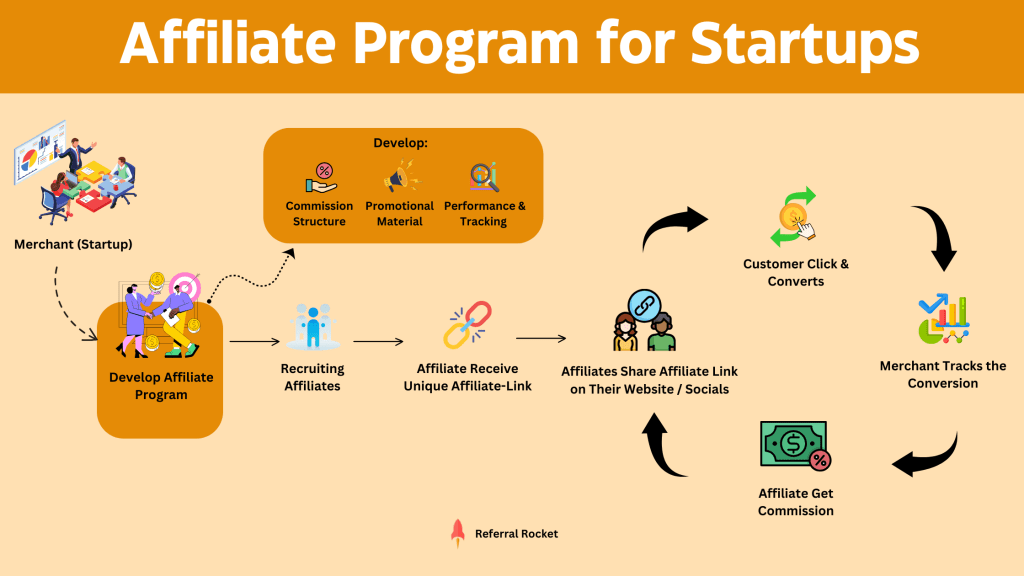
Essentially, it starts with a startup defining its affiliate program, which includes the commission structure, promotional materials, and performance tracking. Once the program is established,
The next step is recruiting affiliates, who will promote the startup’s offerings to their audiences through various channels such as blogs, social media, or email marketing.
Once an affiliate joins the program, they receive unique tracking links or codes that allow the startup to track traffic and sales generated by each affiliate. When customers click on these links and make a purchase, the affiliate earns a commission based on the agreed-upon rate.
This entire process is streamlined through affiliate marketing platforms that handle tracking, reporting, and payment processing.
What this model means for the startups is that you only invest in marketing efforts that deliver measurable outcomes, such as sales or leads.
Stat to note : According to a study by Forrester Consulting and commissioned by Rakuten Advertising statistics, over 80% of brands run affiliate programs, successfully generating significant sales at lower acquisition costs compared to traditional advertising methods.
How Affiliate Marketing Benefits Startups
Affiliate marketing has numerous benefits, making it an attractive option for small businesses looking to establish a foothold in the market. Listing all of them in a single blog would be quite a challenge, so here are some of the notable advantages that enable startups to perform more efficiently.
1. Cost-Effectiveness
Unlike traditional advertising, affiliate marketing operates on a performance-based model. You pay affiliates only when they deliver results, such as a sale or lead. This minimizes wasted spending and ensures every dollar contributes to your growth.
Research by ResearchGate has shown that well-executed affiliate programs can reduce overall customer acquisition costs (CAC) while increasing efficiency
2. Enhanced Customer Loyalty
Affiliate referrals often come with an element of trust, as affiliates typically recommend products to audiences who value their opinions. This trust translates into higher customer retention rates and increased loyalty, which boosts your customer lifetime value (CLV).
3. Scalability & Broader Reach
Startups can start with a small number of affiliates and gradually expand their program as they grow. This flexibility allows businesses to adjust their marketing efforts based on performance and market conditions without incurring excessive costs.
Moreover, startups can tap into a wide range of affiliates, from influencers to niche bloggers, enabling them to reach diverse audiences and markets that may be difficult to penetrate through other marketing channels.
4. Measurable and Strategic Impact
Affiliate marketing allows for detailed tracking and analytics. Startups can monitor which affiliates are performing well, optimize their campaigns, and allocate budgets accordingly. This ensures every action is backed by data, reducing risks and maximizing returns.
5. Building a Network of Advocates
Affiliate marketing doesn’t just bring in customers—it builds a community of advocates. Affiliates act as brand ambassadors, actively promoting products or services to their audiences. This network of advocates drives growth, strengthens the brand’s reputation, and creates trust and engagement that benefits startups in the long run.
A Prime Example of a Successful Startup
Here is a Fashion startup leveraging affiliate marketing for their subscription service, Stitch Fix.

By implementing an affiliate program, Stitch Fix was able to leverage the influence of fashion bloggers and social media personalities, driving significant traffic to their site. This strategy not only increased their customer base but also enhanced brand visibility and credibility in a competitive market.

The success of Stitch Fix highlights how targeted affiliate marketing can lead to substantial growth for startups, making it a viable option for those looking to expand their reach and revenue.
How to Choose the Right Affiliate Marketing Program for Startups
Affiliate marketing is a great way for startups to grow their customer base, often the sole motive for startups. But just don’t just get immediately blown away by the potential of it before examining other factors.
Selecting the right affiliate marketing program is crucial for startups looking to maximize their success. The tips below will help you evaluate and choose the program or platform that aligns best with your startup’s needs and budget.
Evaluating Different Affiliate Platforms :
First and foremost, it’s essential to evaluate different affiliate platforms and models to find one that aligns with your startup’s goals and budget. Look for platforms that are user-friendly and offer seamless integration with existing tools, such as e-commerce platforms or customer relationship management (CRM) systems.
Prioritizing Simplicity :
Simplicity in implementation can save valuable time and resources, allowing startups to focus on scaling their affiliate program rather than navigating complex systems.
Prioritize Transparent Commission Structure :
Another critical factor to consider is the transparency of the commission structure. Startups should seek affiliate programs that clearly outline commission rates, payment schedules, and any additional fees involved. Transparency fosters trust between startups and affiliates, encouraging stronger partnerships.
Robust Analytics and Tracking Capabilities
Additionally, robust analytics and tracking capabilities are essential for monitoring performance and optimizing campaigns. Startups should choose affiliate programs that provide detailed insights into traffic sources, conversion rates, and overall sales performance, enabling data-driven decision-making.
To help streamline the evaluation process, consider creating a checklist of what to look for in an affiliate marketing program.
Key elements to include are:
- Integration with startup-friendly tools,
- Transparent commission structures,
- Robust analytics for tracking performance,
- Quality support from the affiliate network.
By keeping these criteria in mind, startups can make informed decisions that lead to the successful implementation of their affiliate marketing efforts.
How to Set Up an Affiliate Marketing Program for Startups
Setting up an affiliate marketing program for a startup involves several key steps to ensure its success
Here’s a step-by-step guide to help you get started:
Step 1: Define Your Goals and Budgets
Determine what you hope to achieve through the affiliate program, whether it’s increased sales, brand awareness, or customer acquisition. Establish a budget for commission payouts and promotional materials, keeping in mind the financial constraints that often accompany startups. This foundational step will guide your decisions as you build the program.
Step 2: Choose the Right Affiliate Software or Tool
Often Managing affiliates manually is nearly impossible. Tracking links, calculating commissions, and monitoring performance manually can lead to errors, inefficiencies, and wasted time, delayed payouts and more.
This is where affiliate management tools are essential.
Invest in affiliate software that aligns with your startup’s needs. Look for tools like Referral Rocket that offer seamless integration with your e-commerce platform, real-time tracking, and user-friendly dashboards to manage affiliate performance.
Step 3: Set Up a Competitive Commission Structure
Once the software is in place, set a competitive commission structure that motivates affiliates to promote your products effectively. Consider offering higher commissions for top-performing affiliates or implementing tiered structures that reward increased sales volume.
Step 4: Onboard Trustworthy Affiliates
Find out individuals or organizations that align with your brand values and target audience. Use affiliate marketplaces, social media, or industry networks to identify trustworthy partners. A thorough vetting process can help ensure quality over quantity.
Step 5: Provide a Training Kit with Resources and Support
Provide your affiliates with the resources they need to succeed, such as brand guidelines, promotional materials, and comprehensive training sessions. Offering these resources helps them understand your products and align with your marketing strategies.
Also, make sure to provide ongoing support to keep your affiliates engaged, motivated, and effective in driving results.
Step 6: Establish a Payment and Payout Procedure
Establish clear payout procedures to ensure timely and accurate compensation for affiliates. Define how often affiliates will be paid and which payment methods you’ll support. Ensure your affiliates are well-informed about the process to maintain trust.
Step 7: Track Performance and Optimize Campaigns
Use analytics tools to monitor affiliate performance. Most affiliate marketing platforms come with built-in analytics dashboards, allowing you to track key metrics and evaluate results. Use this data to identify what’s working and refine your strategies to maximize ROI.

Additionally, maintain regular communication with your affiliates to keep them motivated and aligned with your goals.
Challenges to Consider
Once you start setting up and managing affiliate programs, there are a few challenges to consider. Addressing them will ensure the longevity and success of your affiliate marketing program
1.Tracking Complexities:
Manually tracking affiliate performance can quickly become overwhelming and error-prone. Without proper tools, you risk missing conversions, inaccurately calculating commissions, or even losing valuable data. It’s beneficial to leverage reliable software that ensures all activities are accurately monitored and tracked.
2. Payment Issue
One of the fastest ways to lose affiliate trust is through delayed or inconsistent payouts. Affiliates rely on timely payments for their efforts, and any disruption in this process can harm your relationship with them. Automating this process through dedicated software reduces risks and keeps affiliates motivated.
3. Fraud Prevention:
Fraudulent activities, such as fake conversions or click spamming, can significantly drain your resources and lower the credibility of your affiliate program. Startups are especially vulnerable as they often lack robust mechanisms to detect and prevent fraud. Implementing tools with fraud detection ensures the integrity of your program.
4. Compliance and Brand Alignment:
Ensuring affiliates adhere to regulations, such as General Data Protection Law (GDPR) or FTC endorsement guidelines, is crucial to avoid legal penalties and protect your brand’s reputation. Additionally, affiliates must align with your brand’s messaging and values to ensure consistent representation.
Often, trying to manage these challenges manually becomes a roadblock. Tracking links, calculating commissions, and monitoring performance without automation can lead to inefficiencies, errors, delayed payouts, and wasted time.
This is why a well capable affiliate marketing tool is essential for startups.
Why Referral Rocket is the Perfect Partner for Your Affiliate Program Needs
Referral Rocket is an affiliate and referral management tool that helps startups build scalable affiliate programs to achieve measurable growth. It provides features that simplify the process, such as real-time analytics, seamless integrations with e-commerce platforms, and automated payouts. These tools ensure accurate tracking and efficient management, while also helping prevent fraud and build trust with affiliates.

By leveraging such tools, you can save time, reduce manual workload, and focus on refining your strategy.
For startups, having a reliable system in place can make all the difference in creating a successful and scalable affiliate program.
Conclusion: Key Takeaways for Affiliate Marketing Success
In conclusion, affiliate marketing emerges as a scalable and cost-effective solution for startups looking to enhance their customer acquisition strategies. By leveraging external networks, startups can expand their reach without incurring significant upfront costs. The performance-based nature of this model allows for a higher return on investment, making it an attractive option for businesses operating on limited budgets.
By following the steps outlined in this guide, startups can establish a successful affiliate marketing program that drives sales, increases brand visibility, and fosters sustainable growth.
Startups can take action today—implement these strategies or request a free consultation/demo to kickstart your affiliate marketing journey.