


The business world is filled with acronyms, but few spark as much debate, intrigue, and confusion as MLM (Multi-Level Marketing). For some, it represents a pathway to financial independence and flexible entrepreneurship. For others, it is a model fraught with controversy and risk.
If you are looking to understand the mechanics of this industry whether you are an entrepreneur looking to launch a network marketing company, a developer researching MLM software, or simply an individual trying to separate fact from fiction this guide is for you.
Welcome to MLM 101. In this deep dive, we will explore the history, the structure, the critical differences between legitimate businesses and pyramid schemes, and the massive role technology plays in modern network marketing.
Part 1: What is Multi-Level Marketing (MLM)?
At its core, Multi-Level Marketing (often called network marketing or direct selling) is a business strategy used by some companies to sell products or services. Unlike traditional retail, where products move from manufacturer to wholesaler to retailer to consumer, MLM moves products through a network of independent distributors.
The Structure: Upline and Downline
The defining characteristic of an MLM is the compensation plan, which pays out on multiple “levels.”
- Direct Sales: Distributors earn a profit or commission by selling products directly to consumers.
- Recruitment (The “Multi-Level” Aspect): Distributors are encouraged to recruit new distributors. When they do, they earn a percentage of their recruits’ sales.
This creates a genealogy or family tree structure:
- The Upline: The person who recruited you, and the person who recruited them, and so on.
- The Downline: The people you recruit, and the people they recruit.
A Brief History
The concept of direct selling dates back centuries to traveling hawkers and peddlers. However, the modern MLM structure took shape in the mid-20th century. Companies like California Vitamin Company (which later became Nutrilite) and Avon (initially the California Perfume Company) pioneered the idea of rewarding distributors not just for selling, but for finding other sellers.
By 1959, Rich DeVos and Jay Van Andel founded Amway, which popularized the model globally. Over the decades, the industry has evolved from door-to-door sales of soap and vitamins to high-tech operations selling everything from cryptocurrency education to travel packages, all powered by sophisticated MLM software.
Part 2: The Critical Distinction: MLM vs. Pyramid Schemes
Before diving into the mechanics of software and marketing, we must address the elephant in the room: the legality of the model.
Legitimate MLMs are legal in most countries, including the United States, provided they adhere to specific regulations (such as those enforced by the FTC). Pyramid schemes, however, are illegal and fraudulent.
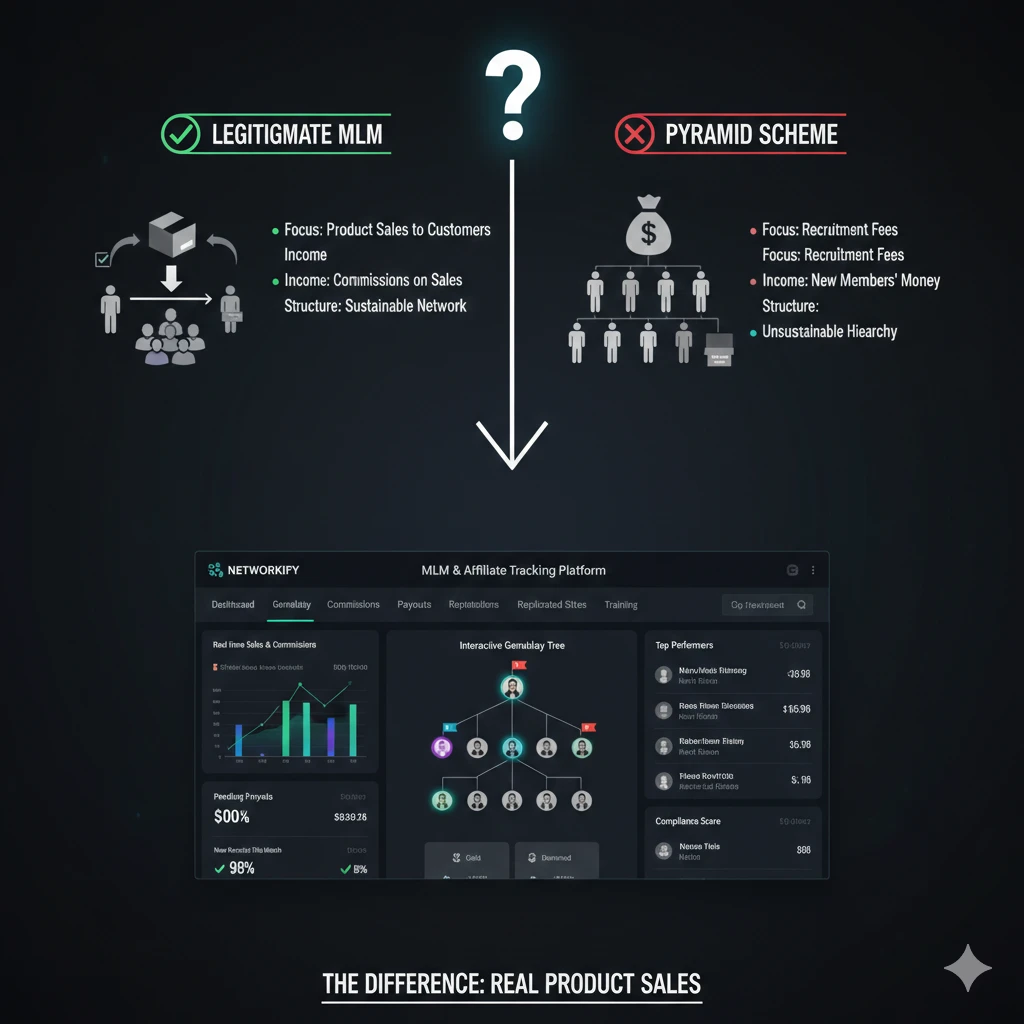
The Litmus Test
How do you tell the difference? It usually comes down to the source of the revenue.
- Legitimate MLM: The primary goal is to sell a tangible product or service to an end consumer. Commissions are earned on sales volume. If recruitment stopped tomorrow, the business could theoretically continue because products are being sold to real customers.
- Pyramid Scheme: The primary source of income is the recruitment of new members. Money is simply moved from new recruits to pay the people at the top. There is often no real product, or the product is just a “token” (overpriced and unsellable) used to disguise the scheme.
Key Takeaway: If you are paid merely for signing people up, it is likely a pyramid scheme. If you are paid because the people you signed up sold inventory to a customer, it is likely an MLM.
Part 3: MLM vs. Affiliate Marketing
In the digital age, the lines between MLM and affiliate marketing often blur, but they are distinct business models. Understanding this difference is vital, especially when choosing the right technology stack, such as affiliate marketing software versus dedicated network marketing tools.
Affiliate Marketing
In affiliate marketing, a brand pays a commission to a partner (the affiliate) for a specific result—usually a sale or a lead.
- Single Level: You promote a link. Someone clicks and buys. You get paid. The chain usually ends there.
- No Recruitment Pressure: Affiliates do not typically need to recruit other affiliates to make money.
- Digital Focus: It is predominantly an online activity relying on SEO, content marketing, and paid traffic.
Multi-Level Marketing
MLM is inherently hierarchical.
- Multiple Levels: You are paid on the sales of people you didn’t personally sell to (your downline).
- Mentorship: There is a heavy emphasis on training, motivating, and managing a team.
- Personal Contact: Historically, MLM relies more on “warm markets” (friends and family), though this is changing with social media.
The Hybrid Model
Interestingly, the modern economy is seeing a convergence. Many SaaS (Software as a Service) companies now offer “two-tier” affiliate programs. This is where affiliate software begins to look a bit like MLM software.
- Example: A software company pays you 20% on your sales, and 5% on the sales of any other affiliate you refer to the program. This borrows the “leverage” concept of MLM without the complex rank advancements and strict compliance requirements of a full network marketing company.
Part 4: The Engine Room: The Role of Software in MLM
If you are planning to start an MLM, or if you are a distributor trying to understand the tools provided to you, you must understand the technology. You cannot run a modern multi-level marketing company on a spreadsheet. The mathematical complexity of calculating commissions for thousands of people across dozens of levels requires robust solutions.
This is where the search for the right MLM software becomes the most critical decision a business owner makes.
1. Complex Commission Calculations
Standard affiliate marketing software is designed to track a simple transaction: Visitor A clicked Link B and bought Product C.
However, MLM compensation plans are far more intricate. Common structures include:
- Unilevel: You can recruit as many people as you want on your “frontline.”
- Binary: You are limited to two legs (left and right), requiring you to balance volume between them.
- Matrix: A forced structure (e.g., a 3×9 matrix) where spillover occurs.
MLM software must calculate these commissions in real-time, often processing millions of data points to ensure that a sale made by a distributor 15 levels deep correctly triggers a $0.50 commission to the person at the top of the pyramid.
2. Genealogy Tracking
In a standard affiliate program, you rarely care who your affiliate’s affiliate is. In MLM, that lineage is everything. Top-tier MLM affiliate software provides visual “Genealogy Trees.” These are interactive dashboards where a user can zoom in and out of their network, identifying which branches are performing well and which need support.
3. E-Wallets and Payouts
Paying 50 affiliates at the end of the month is easy. Paying 50,000 distributors in 12 different countries with different tax laws is a nightmare. Dedicated MLM software usually integrates with “payout gateways” or internal E-Wallets. This allows distributors to hold their funds within the platform and request withdrawals to their bank accounts or prepaid cards, ensuring the company stays compliant with financial regulations.
4. Replication Sites
When a new distributor joins, they need a website immediately. MLM software automatically generates “replicated websites.”
- Main Site:
www.ExampleCompany.com - Distributor Site:
www.ExampleCompany.com/jane-doe
The software ensures that any purchase made on Jane’s URL is automatically tracked to her ID. While some affiliate software offers basic referral links, replicated sites in MLM often allow for personalization, adding a bio, and even running a mini-blog to help the distributor build their personal brand.
Part 5: Choosing the Right Tech: Affiliate Software vs. MLM Software
This is a common pain point for startups. “Do I need expensive enterprise MLM tools, or can I get away with cheaper affiliate marketing software?”
When to use Affiliate Marketing Software
If your compensation plan is simple (single tier or strictly two-tier) and you do not require distributors to purchase “starter kits” or maintain “rank qualifications,” standard affiliate software is likely sufficient.
- Pros: Lower cost, easier setup, better integration with tools like Shopify or WordPress.
- Cons: Cannot handle binary/matrix plans, lacks genealogy visualization, limited “gamification” features for ranks.
When to use MLM Software
If your business model involves “Ranks” (e.g., Silver, Gold, Diamond) based on group volume, or if you need to enforce rules like “compression” (skipping inactive members), you must use dedicated MLM software.
- Pros: Built specifically for the industry, handles compliance, includes learning management systems (LMS) for training.
- Cons: Higher monthly fees, longer setup time, often requires custom development.
The Rise of “MLM Affiliate Software”
A new category of hybrid tools is emerging, often dubbed MLM affiliate software. These platforms bridge the gap. They offer the ease of use of standard affiliate tracking but include add-ons for multi-tier commissions and basic genealogy tracking. This is often the sweet spot for modern direct-to-consumer (DTC) brands that want to add a “network marketing lite” component to their business without going full corporate MLM.
Part 6: The Pros and Cons of the MLM Model
For the entrepreneur considering this model, it is essential to weigh the benefits against the inherent challenges.
The Pros
- Low Barrier to Entry: Unlike franchising (which costs thousands), joining an MLM usually costs very little.
- Scalability: For the company, the fixed costs are low because the sales force works on commission. You don’t pay for health insurance or base salaries for your sales team.
- Viral Growth Potential: If the product is good and the incentives are right, an MLM network can spread across a country faster than almost any other business model.
- Community: Strong MLMs build fanatical communities that provide social support, training, and a sense of belonging.
The Cons
- High Failure Rate: Industry statistics consistently show that the vast majority of MLM participants earn little to no money.
- Inventory Loading: A common pitfall is distributors buying more product than they can sell just to qualify for commissions. (Note: Good MLM software often has compliance triggers to prevent this).
- Reputation Risk: The industry is plagued by “get rich quick” stigma. Even legitimate companies often face skepticism.
- Relationship Strain: The “warm market” approach (selling to friends) can strain personal relationships if not handled with high emotional intelligence.
Part 7: Legal Landscape and Compliance
If you are setting up an MLM, or if you are evaluating one, you must understand the “70% Rule” and the “Amway Safeguards.”
In the landmark FTC v. Amway case (1979), Amway was ruled not a pyramid scheme because they had safeguards in place. If you are configuring your MLM software, you should look for features that enforce these rules:
- The 10-Customer Rule: Distributors must make sales to at least 10 different retail customers per month to qualify for commissions.
- The 70% Rule: Distributors must sell at least 70% of the inventory they purchased before they can order more.
Modern MLM software helps enforce this by requiring distributors to log retail sales receipts before releasing commission checks. If you are looking for affiliate marketing software to run an MLM-style program, ensure it has the capacity to differentiate between “internal consumption” (what the affiliate buys for themselves) and “external sales” (what real customers buy). The FTC looks very unfavorably on companies where the only buyers are the distributors themselves.
Part 8: Tips for Success in MLM
Whether you are building the company or joining one, success leaves clues.
For the Company Owner
- Focus on Product First: Your product must be viable in the open market. If people wouldn’t buy it without the “business opportunity” attached, you are on shaky ground.
- Invest in Good Tech: Do not scrimp on your MLM software. A system crash on commission payout day can destroy trust instantly. Ensure your affiliate software provider offers robust support and server uptime.
- Transparency: Be clear about average earnings. Publish an Income Disclosure Statement (IDS) prominently.
For the Distributor
- Treat it Like a Business: This is not a lottery ticket. It requires hours of dedication, lead generation, and follow-up.
- Diversify: Do not rely solely on your warm market. Learn digital marketing strategies.
- Use the Tools: Master the MLM affiliate software your company provides. Learn how to pull reports, track your customer retention, and analyze your downline’s performance. Data is your best friend.
Conclusion
Multi-Level Marketing is a complex, high-energy industry that sits at the intersection of psychology, sales, and sophisticated technology. It offers a unique leverage that traditional business models cannot match, but it comes with higher regulatory scrutiny and a need for ethical leadership.
For the modern entrepreneur, the distinction between “affiliate marketing” and “MLM” is becoming a choice of software architecture as much as a choice of business strategy. Whether you choose a lightweight affiliate marketing software to run a referral program, or an enterprise-grade MLM software to manage a global sales force, the goal remains the same: moving quality products into the hands of happy consumers.
As with any venture, due diligence is key. Understand the compensation plan, vet the product, and ensure the technology stack is built for the long haul.