

Table of Contents
- Referral Program Costs
- What is Referral ROI and How to Calculate it?
- Additional Referral Program Metrics you can Track
There’s a reason why customer referral programs are popular: the kind of attention your business gets from referred customers is immense. You tend to attract loyal customers who are most likely to make repeated purchases and stick with you for the longest time.
Let’s look at some examples:
- Dropbox grew 1300% in 15 months through a simple referral program.
- Uber’s Get a Free Ride referral program generated a 12x ROI.
- Airbnb’s referral program increases sign-ups by 300%.
- PayPal’s referral program increased daily growth by 7–10%, resulting in a user database of over 100 million.
Having referral programs for businesses is becoming more and more necessary. But how do you know if your referral program is working and growing revenue for your business?
That’s exactly what we are going to discuss in this article. If you have a referral program or aim to create one for your business, read this article because you will get to know about everything regarding referral ROI and Referral costs.
Referral Program Costs
While calculating referral program costs, you need to consider three things:
- Pricing of Referral Software
- Cost of referral rewards you offer
- Investment in referral campaign planning
Pricing of Referral Software
Referral marketing software helps you manage referral campaigns by tracking down your most active participants, automating your reward processing, and providing you with insights into your referral program performance.
The good news is that there are plenty of options for referral marketing software. The ideal option will rely on your needs and budget.
The price of the software you choose for your referral program will determine how much it costs overall. While some solutions cost thousands of dollars a month, others only cost a few hundred.
For example, Referral Rocket offers a forever-free plan. For more advanced users it also offers three additional paid plans that you can opt for starting from $39. If you require advanced features and Rest API integrations you can opt for Pro and Enterprise Plan but if you have minimal requirements, going with a basic plan is ideal.
Cost of Referral Rewards You Offer
In addition to the referral software, referral costs will be determined by the kind of referral rewards you want to offer. Offering cash rewards can be more expensive than subscription points or discounts. However, cash prizes are good at generating short-term traction and attracting customers in large numbers to join referral programs.
If your product or service is pay-per-use based, then offering subscription points and credits can be useful because that excites your audience. Discounted services surely boost sales and customer engagement which positively impact your business.
Investment in Referral Campaign Planning
To manage referral campaigns, you will need to have an employee to oversee it and let’s say you are not hiring a full-time employee to manage it. So anyone from the marketing team can dedicate their time to run campaigns. To manage referral campaigns, on average an employee should take 25% of their time.
You should calculate the number of hours the employee will spend overseeing the program and multiply the result by their average hourly wage to get the cost of running a referral program. For example, suppose the worker’s hourly wage is $35 and they will oversee the program for three hours a week. The estimated monthly cost comes down to $420 or $5,040 per year.
What is Referral ROI and How to Calculate it?
Referral ROI, or Return on Investment, is a metric used to evaluate the effectiveness and profitability of a referral program. In simple terms, it measures the financial return a company gains from the resources invested in its referral initiatives.
We use a simple formula to calculate Referral ROI.
ROI = (Expected Payoff – Total Investment) / Total Investment
The expected Payoff is calculated by subtracting the average referee reward from the Customer’s Lifetime Value and multiplying the result by the Total Referrals made.
Expected Payoff = Total Referrals Made * (LTV – Average referee reward)
Total Investment is calculated by multiplying the Average Referral Reward with the Total Referrals made and then adding the result to the Marketing Spend.
Total Investment = Marketing Spend + ( Total Referrals Made * Average Referrer Reward)
Glossary:
| Term | Definition |
| Customer Lifetime Value | Customer lifetime value is a metric that is used to determine the total amount of money customers will spend on your products or services over a period of time. |
| Referee reward | Referee reward is the incentive you offer to the referred customers. |
| Referrer reward | Referrer reward is the incentive you offer to the referrer who referred their friends and family. |
| Marketing spend | Marketing spend is the total money a company spends on referral programs such as referral rewards, referral software and salaries paid to the employees who run referral programs. |
Let’s look at an example where a company called ‘Clate’ created a referral program for their customers by rewarding $20 to customers (both referrer and referee) who joined the referral program. The LTV of those customers is $100, and marketing spend for the referral program is $600. Clate received a total of 2250 referrals from customers (total referrals made).
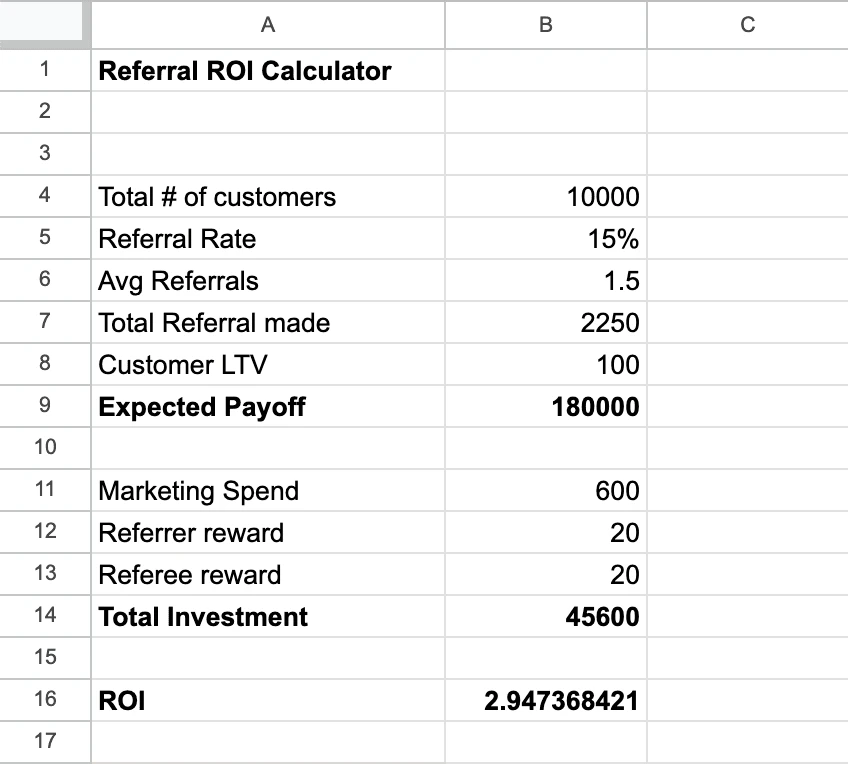
Expected Payoff = (Total referrals made * (LTV – Average referee reward))
(2250 * (100 – 20))
180000
Total Investment = Marketing Spend + (Total referrals made * Average referrer reward)
600 + (2250 * 20)
45600
Return on Investment = (Expected Payoff – Total Investment ) / Total Investment
2.94x
Use our calculator with prebuilt formula to easily calculate the ROI for your referral program Referral Program ROI Calculator
Additional Referral Program Metrics you can Track
To determine the overall impact of your referral program, you can also track the following metrics. Here’s how to calculate them.
1. Active Engagement Rate
This metric determines the percentage of customers that participate in your referral scheme regularly.
To determine the active engagement rate, trace the percentage of total customers who have earned or spent the rewards in your e-commerce store or on your website within a specific period.
2. Rate of Conversion
The conversion rate is the total percentage of referred friends who purchase from your business, based on the number of total referred friends who click a referral link.
For instance, your conversion rate is 9%, if 6,500 friends click on a referral link and 600 of those friends make a purchase.
3. Participation Rate
The percentage of consumers who have shared your brand through the referral program is the participation rate. It is also called the share rate. The participation rate is measured because it helps in monitoring the effectiveness of your referral program. You may need to adjust your promotion channels or rewards if your participation rate is lower than you had expected.
4. Referral Rate
The referral rate measures the percentage of total purchases made that come from referred customers. This rate is usually calculated on a monthly or yearly basis.
For example, if six out of every 100 purchases came from customer referrals last month, your monthly referral rate would be 6%.
Whats a good referral rate? Learn more about how to improve referral rates.
5. Brand Awareness
Apart from calculating ROI on converted referrals, you might want to consider other things such as increased brand awareness.
Referred leads will learn about your brand when they click the link their friend sends them (whether or not they purchase right away). Now that they are aware of what your brand can help with, they might come back and purchase later.
Tracking the traffic generated from your program shows you if the messages and offers shared by your referring customers bring people to your website.
By calculating your referral marketing Return on Investment (ROI) you can figure out if your program is meeting its goals or if it needs improvement. Your return on investment (ROI) is good if your program’s revenue exceeds the costs associated with bringing on new clients or if you find that the customer lifetime value of referred clients is higher. For Best RROI, choose a referral software like Referral Rocket that completely automates the referral process making it easy for you to run campaigns effectively.