

There’s a quiet shift happening in the affiliate world.
Top creators — the ones running profitable Telegram channels, niche newsletters, and YouTube product roundups — are quietly pulling their links off big affiliate networks like CJ, ShareASale, and Rakuten.
They’re not quitting affiliate marketing.
They’re just leaving the old way of doing it behind.
Instead of waiting days to get approved, digging through confusing dashboards, or promoting offers with terrible conversions, they’re now browsing open affiliate marketplaces — spaces where new brands list their programs directly, payouts are transparent, and onboarding happens in hours, not weeks.
“I made more in 3 weeks from an open marketplace offer than I did in 3 months on ShareASale.”
— A D2C creator with 10K+ Telegram followers
This blog dives deep into why top affiliates are making this move, what’s broken in traditional networks, how open marketplaces work, and how you — whether you’re a creator or brand — can take advantage of this shift before it becomes saturated.
What Are Traditional Affiliate Networks (And Why They Used to Work)?
Before we talk about what’s broken, let’s quickly define what traditional affiliate networks actually are.
These are third-party platforms — think Commission Junction (CJ), Rakuten, ShareASale, Impact, and Awin — that act as the middlemen between brands and affiliates.
They’ve been around for 10–20 years and built massive ecosystems with:
- Big-name merchants (Nike, GoDaddy, Bluehost, etc.)
- Tools to track clicks, commissions, and payments
- Centralised dashboards to apply for offers
- Performance analytics for brands and creators
For a long time, they worked well, especially for:
- SEO-heavy affiliates writing comparison blogs
- Coupon or cashback sites
- International publishers
And they made sense in a world where:
- Most affiliates were web-based
- Brands needed third-party trust
- Payouts require global processing
- Creator partnerships didn’t exist
Why They Used to Be Valuable
| Feature | Value Then |
| Brand trust | Affiliates could partner with known companies without emailing them directly |
| Central tracking | Simplified data reporting and dashboarding |
| Compliance | Networks handled contracts, disclosures, and fraud |
| Volume | One login gave you access to 100s of programs |
| Payments | Globalised systems made multi-country payouts possible |
Back in 2010–2017, when affiliate marketing was more niche and technical, these networks felt like gold mines.
But now, in 2025? That model is starting to crack.
What’s Changed in 2024–25 for Affiliates
The affiliate landscape in 2025 looks completely different from what it was even five years ago.
Today’s top affiliates are not necessarily SEO bloggers or cashback websites. They are:
- Telegram channel owners with niche communities
- Newsletter writers with 10K–100K loyal readers
- YouTubers and podcasters are building brand trust
- LinkedIn creators with engaged B2B audiences
- Micro-influencers focused on conversion, not vanity metrics
These creators don’t want to fill out 4-page forms or wait 10 days to get a tracking link.
They want:
- Speed
- Transparency
- Creative freedom
- Better payouts
- Direct brand access
The Creator Economy Has Changed Affiliate Behaviour
Let’s break it down:
| Then (Old Affiliates) | Now (Modern Affiliates) |
| SEO/blog-focused | Creator-led (Telegram, YouTube, email) |
| Mass offers | Niche, audience-fit offers |
| Passive content | Actively engaging the audience |
| OK with delays | Want to promote this week |
| Network dependency | Prefer direct access and tools |
This shift is why traditional networks now feel too slow, too complex, and too disconnected from how modern creators operate.

New Affiliates Think Like Consumers
Affiliates today browse affiliate programs like they shop for tools.
They ask:
- “Is this product worth promoting to my audience?”
- “Can I sign up fast?”
- “Will this actually convert?”
- “Is the brand responsive?”
- “Are the assets provided, or do I need to build everything?”
They don’t want a 2-week application cycle or a giant list of expired links.
They want to discover offers, apply with one click, and start earning fast.
This is where open affiliate marketplaces are winning — and traditional networks are falling behind.
Why Traditional Networks Just Don’t Work for Today’s Affiliates
Let’s be honest — if you’ve ever tried using a big affiliate network like CJ, ShareASale, or Rakuten as a creator, you’ve probably said this at least once:
“Why is everything so slow?”
And you’re not wrong.
What used to feel like a smart way to access multiple affiliate programs now feels outdated, especially when you’re a creator who wants to move fast.
Let’s break down the real issues affiliates are fed up with:
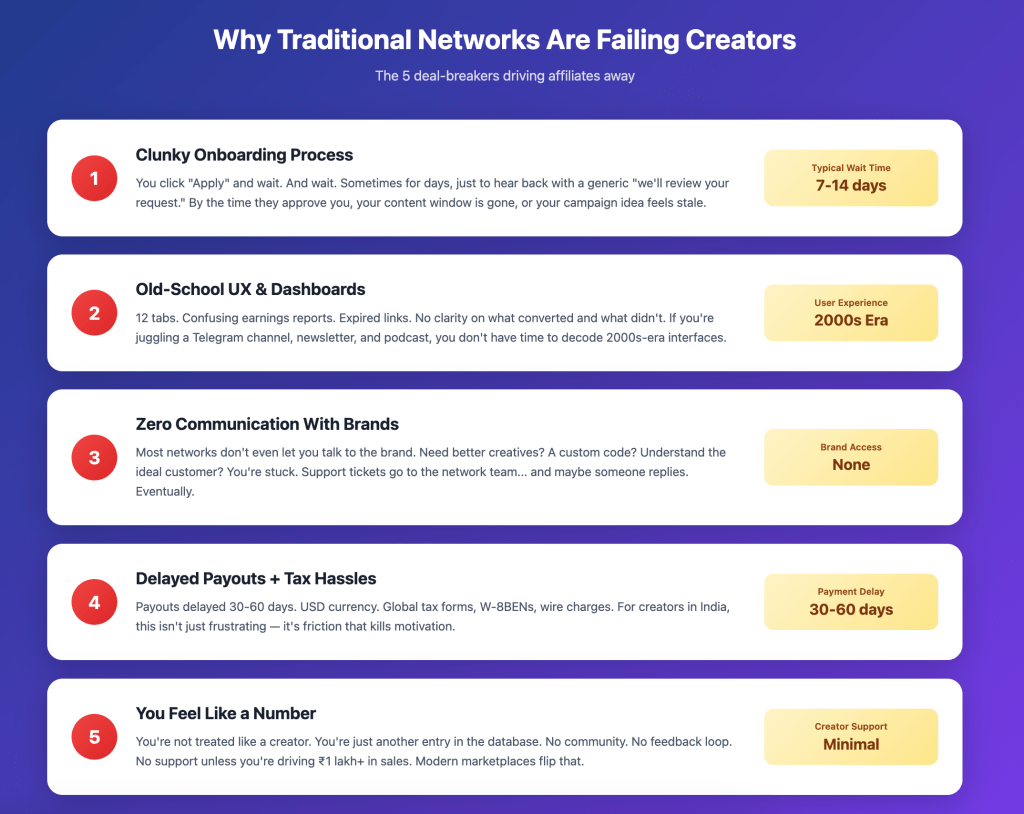
1. Clunky Onboarding Process
You click “Apply” and wait.
And wait.
Sometimes for days, just to hear back with a generic “we’ll review your request.”
By the time they approve you, your content window is gone, or your campaign idea feels stale.
Creators don’t work that way anymore. We batch content. We schedule posts. We move fast. Traditional networks slow that down.
2. Old-School UX and Dashboards
Have you seen some of those dashboards?
- 12 tabs
- Confusing earnings reports
- Expired links
- No clarity on what was converted and what wasn’t
If you’re a creator juggling a Telegram channel, a newsletter, and maybe even a podcast, you don’t have time to decode 2000s-era interfaces. You want clean dashboards, real-time stats, and instant access.
3. Zero Communication With Brands
This one’s big.
Most traditional networks don’t even let you talk to the brand. If you want to:
- Ask for better creatives
- Request a custom code
- Understand the ideal customer
- Share feedback on conversions
…you’re stuck.
You send a support ticket, it goes to the network team, and maybe someone replies.
Eventually.
In marketplaces like Referral Rocket? You DM the brand directly. You build relationships. You grow together. That’s how top creators scale.
4. Delayed Payouts + Global Tax Hassles
In many traditional networks, payouts are:
- Delayed 30–60 days
- In USD
- Through global systems with tax forms, W-8BENs, wire charges, etc.
For creators based in India, this isn’t just frustrating — it’s friction that kills motivation.
Now compare that to a modern affiliate marketplace built for creators in India:
- INR payouts via UPI or Razorpay
- Fixed payout days
- No tax confusion or PayPal headache
5. You Feel Like a Number
This is probably the worst one.
You’re not treated like a creator. You’re just another entry in the database.
No community.
No feedback loop.
No support unless you’re driving ₹1 lakh+ in sales.
Modern marketplaces flip that. You’re not a number — you’re a partner.
What Are Open Affiliate Marketplaces (And Why Affiliates Love Them)?
Now let’s talk about what’s replacing the traditional networks — and why creators are flocking to it.
Open affiliate marketplaces are platforms where:
- Brands list their affiliate programs
- Creators browse offers by niche, payout, format, etc.
- They apply instantly and start promoting the same day
- No gatekeepers, no waitlist, no BS
Think:
“Upwork for affiliate deals.”
Or
“Zomato for affiliate programs.”
Referral Rocket is one of the new players doing this right, especially for India-first brands and Telegram, newsletter, and LinkedIn creators.
What’s Different (and Better)?
Let’s compare side-by-side:
| Feature | Traditional Networks | Open Marketplaces |
| Signup time | Days/weeks | Minutes |
| Direct brand access | Rare | Always |
| Payouts | Delayed, global | INR, fast |
| Asset sharing | Limited | Built-in |
| Creator focus | SEO/blogs | Telegram, newsletters, micro-creators |
| Support | Ticket-based | DM + real onboarding |
You don’t need to fill out a corporate form.
You don’t need 100K followers.
You don’t need to wait 2 weeks to get a tracking link.
If you’re a real creator with an engaged audience — even if small — you can:
- Discover relevant programs
- Apply today
- Get creatives, tracking links, and bonus offers
- And start earning this weekend
Let Us Understand Through An Example
Let’s say you run a wellness-themed Telegram channel with 15,000 followers.
Old way (ShareASale):
- You apply to 5 brands
- Wait a week
- Get rejected by 2 for “audience mismatch”
- Finally get accepted into 1
- Payout is $3 per sale
- You give up
New way (Referral Rocket):
- You browse “Health & Wellness” offers
- Filter by INR payouts
- Apply to 3 brands — instant access
- One offers ₹500 per sale and pre-made Telegram posts
- You promote tonight
- The first sale happens in 48 hours

Why Top Affiliates Are Making the Switch
This shift isn’t just hype.
Top affiliates — especially the ones who make serious monthly income — are actively moving away from traditional networks and toward open marketplaces.
Let’s break down why they’re doing this and what they’re gaining.
1. Speed Over Red Tape
In traditional networks, applying to a program feels like trying to get into a gated club.
You submit an application.
Wait days.
Sometimes, never hear back.
Even if you’re a high-performing affiliate.
Top creators don’t have time for that. They’re not sitting on one blog post hoping it ranks. They’re running:
- Telegram flash deals
- Weekend email campaigns
- Weekly YouTube roundups
- Community-led content drops
They need to discover new offers and promote within hours, not weeks. Open marketplaces let them do that. You browse, apply, and go live. Same day.
2. Direct Relationships = Better Everything
Top affiliates aren’t just posting links. They’re asking brands:
- What works for your buyers?
- Can I get a custom code for my audience?
- Can you tweak the landing page to convert better?
These kinds of questions are impossible inside traditional networks. You’re not even allowed to contact the brand directly.
But in open marketplaces like Referral Rocket, the brand is one click away.
Want a custom Telegram banner? Ask.
Need a shorter checkout flow? Say so.
This feedback loop is what turns a casual affiliate into a top performer.
3. Payout Clarity and Control
Let’s be honest: most affiliates don’t trust traditional networks anymore when it comes to payouts.
- Payment timelines are vague
- You don’t know if that sale got tracked
- You chase down commissions for weeks
Now compare that to open marketplaces:
- Clear: “You get ₹500 per conversion, paid on the 1st of every month.”
- Transparent: Real-time tracking and approval status
- Local: INR payouts, UPI or Razorpay, no conversion fees or delays
This control builds confidence, and confidence makes creators promote harder.
4. Better Offer Quality
The old assumption was: “Bigger networks have better offers.”
That’s no longer true.
Most top affiliates now look for:
- Unique brands with strong value props
- Higher payouts (₹300–₹1,000 per sale, not 5% commission)
- Niche alignment (“this fits my Telegram/YouTube audience”)
- Early access to rising D2C or SaaS brands
These offers often don’t exist in legacy networks, but they do get listed first in open marketplaces looking to grow fast.
So while traditional networks are filled with ageing programs and low-payout brands, top affiliates now chase high-EPC, conversion-friendly offers in smaller, creator-first platforms.
5. More Support, Less Noise
Top affiliates care about support. But not the kind that sends a ticket to “support@giantnetwork.com”.
They want:
- Real onboarding
- Co-created promo ideas
- Insights from other creators
- Live updates from the brand
Open marketplaces, especially those with built-in messaging or communities, give that.
You’re not guessing how to promote.
You’re part of a creator-brand engine that shares what’s working, so everyone earns more.
What Affiliates Gain — and What Brands Get Too
This shift isn’t just great for affiliates.
Open marketplaces are mutually better for both sides.
Let’s break it down.
What Affiliates Get
- Faster Time to Earnings
Instead of waiting a week for approval, you sign up and start promoting within hours. Some creators have seen commissions land within 48 hours of joining. - Better-Fit Offers
Niche marketplaces are curated. You don’t have to sift through 2,000 random brands. You’re seeing D2C, SaaS, wellness, creator tools — all sorted, filtered, and ready. - No Middlemen
Talk to the brand. Get your questions answered. Request bonuses or promo codes. It’s transparent and personal — just the way creators work best. - Tools That Work for Creators
Instead of dashboards built for coupon sites, marketplaces now give you:
- Telegram-friendly content
- Newsletter-friendly banners
- One-click tracking links
- INR payouts without tax paperwork mess
- More Trust, Less Guessing
Open marketplaces often show conversion rates, average payouts, and even “Top Earning Creator Last Month” data. That makes it easier to bet on the right offer.
What Brands Get (And Why They’re Listing Here)
- Higher Engagement from Affiliates
No more “100 signups, 4 active” problems. The creators applying to marketplaces are serious because they chose you. - Faster Scaling
Your affiliate funnel doesn’t take 6 weeks to get moving. You can go from “listed” to “earning” in 72 hours if you respond to DMs, share assets, and onboard well. - Direct Feedback Loop
Creators share what’s working: which hooks click, which audiences convert, which banners flop. You get free market insight while they promote. - Smarter Distribution
Instead of relying on just blogs, you’re now reaching:
- Telegram micro-communities
- B2B LinkedIn influencers
- Personal finance newsletters
- WhatsApp commerce groups
All with zero CAC.
- Stronger Brand Partnerships
The best creators stick with brands that treat them like partners, and marketplaces encourage that connection from day one.
How to Start Moving Without Killing Your Current Income
Switching from traditional networks doesn’t mean you abandon what’s already working.
Here’s how top creators make the shift without risk:
Step 1: Keep Old Links Active (Don’t Ditch, Just Add)
If your blog or video is earning from a legacy network, let it keep running.
But don’t stop exploring.
Pick 1–2 new offers from a niche marketplace and promote those through a different channel — your email list, your Telegram, or a weekend post.
You’ll be surprised how fast you see the difference.
Step 2: Run a Simple A/B Promo
Let’s say you promote a ₹299 product via two different networks.
- In Network A (traditional), you earn 5% = ₹14.
- In Marketplace B (open), they pay ₹150 per sale flat.
Same traffic. One earns you ₹14. The other, ₹150.
Now you have data, not guesswork.
Step 3: DM the Brand. Build a Relationship.
This part is often skipped, but it’s where big affiliates get ahead.
- Ask for content
- Share what your audience likes
- Offer to test new angles
- Request bonuses for high performers
Open marketplaces make this easy — you don’t have to go through a “network rep.” You just message the brand like a human.
Step 4: Test Across New Channels
Try pushing an open marketplace offer on:
- A niche Telegram group
- A creator collab on X (Twitter)
- A Sunday newsletter drop
- A WhatsApp broadcast: You’ll often get better conversion rates than blog traffic, especially when the offer is fresh and fits the channel tone.
Step 5: Track EPC, Not Just Payout
Many creators get distracted by “₹500 per sale.”
But the real number to watch is EPC: Earnings Per Click.
- If Offer A gets 1 sale in 100 clicks = ₹500/100 = ₹5 EPC
- If Offer B gets 4 sales in 100 clicks = ₹200 x 4 = ₹800 → ₹8 EPC
That’s how real affiliates measure winning offers — and open marketplaces often give you this data upfront.
Conclusion: Affiliates Who Want Control Are Already Leaving
The old networks aren’t broken — they’re just built for a world that doesn’t exist anymore.
Today, affiliates don’t want to wait. They don’t want to guess. They don’t want to be treated like a line item in a spreadsheet.
The top 1% of creators are already switching because it gives them better payouts, better partners, and better results, with half the friction.
If you’re an affiliate, you don’t need to ditch everything and jump ship.
Start small. Explore one or two offers. DM a brand. Try something new.
And if you’re a brand?
Stop waiting for affiliates to find your “partner with us” page. Go where they’re already browsing, already promoting, already earning.The next wave of affiliate marketing isn’t gated.
It’s open.
And the people moving fast are already earning faster.