


- Introduction
- Chapter 1: Understanding referral marketing
- Chapter 2: Planning your referral strategy
- Chapter 3: Designing your referral campaign
- Chapter 4: Promoting your referral campaign
- Chapter 5: Creating and launching your referral campaign
- Chapter 6: Optimizing and scaling your referral campaign
- Chapter 7: Case studies and success stories
- Chapter 8: Conclusion
Introduction
When I first started a software business back in 2015, in order to grow faster, I poured thousands of dollars into Google ads, hoping to catapult my B2C software company into the spotlight. However, despite the hefty investment, I found myself in a frustrating cycle of minimal traction, lackluster customer acquisition, and dwindling traffic. As a small business competing in a saturated market, the reality was harsh: my ad placements consistently fell victim to higher bidders, leaving my efforts seemingly futile.
It was a pivotal moment when I realized that to thrive in the competitive landscape, I needed to pivot away from traditional advertising avenues and embrace a more strategic approach. Faced with the pressing need to curb costs while still driving meaningful growth, I delved into the realm of word of mouth marketing solutions and decided to use a referral software.
Referral Marketing: A Game-Changer in Customer Acquisition:
Although referrals are not new, it soon proved as a beacon of hope, offering a potent solution to my predicament. Its significance in driving customer acquisition and sales cannot be overstated. Unlike traditional advertising methods that often struggle to cut through the noise, referral programs leverage the power of existing customers to acquire new customers.
By tapping into the goodwill and trust cultivated among satisfied users, word of mouth marketing possesses an inherent advantage. It harnesses the organic propensity of individuals to recommend products or services they genuinely believe in. This authentic endorsement carries unparalleled weight, bypassing the skepticism often associated with overtly promotional content.
As I scoured the internet for a referral software, I found myself overwhelmed by the myriad options available. My criteria were clear: simplicity, cost-efficiency, and quick implementation without extensive engineering resources. While I stumbled upon a promising candidate, it was still in its infancy. Unfortunately, we settled for a costly, convoluted alternative, which I cannot disclose here as we’ve since evolved into a competitor.
Preview of the Guide:
In this comprehensive guide, I will navigate the intricacies of setting up and optimizing a successful referral program. Drawing from my own experiences and insights gained through trial and error, I will walk you through actionable steps to harness the full potential of referral marketing for your business.
Key Components of the Guide:
- Defining Program Objectives: I’ll delve into the importance of setting clear objectives for your referral program, aligning them with your overarching business goals.
- Crafting Compelling Incentives: Learn how to design enticing incentives that motivate both referrers and referees to actively participate in your program.
- Streamlining the Referral Process: Discover strategies for creating a seamless and user-friendly referral process that maximizes conversions and minimizes friction.
- Promoting Your Program: Explore effective tactics for promoting your referral program across various channels, amplifying its reach and impact.
- Launching and Managing Your Program: Gain insights into the practical aspects of launching and managing a referral program, from setting up tracking mechanisms to providing ongoing support to participants.
- Optimizing and Scaling: Learn how to analyze program performance, identify areas for improvement, and scale your referral program for sustained growth.
Chapter 1: Understanding Referral Marketing
1.1 What is Referral Marketing?
Referral marketing is a strategic approach to acquiring new customers through the power of recommendations from existing customers or affiliates. In today’s landscape, where trust and authenticity are paramount, referral marketing plays a pivotal role in modern marketing strategies. Unlike traditional advertising, which relies on paid promotions to reach audiences, it leverages the trust and credibility inherent in personal recommendations.
Referral marketing differs from traditional advertising in its organic nature. While traditional advertising involves brands directly promoting their products or services through various channels, referral marketing relies on satisfied customers or affiliates voluntarily recommending a product or service to their network. It transcends the boundaries of paid advertising by tapping into existing customer relationships and networks, fostering genuine endorsements that resonate with potential customers.
Moreover, it distinguishes itself from word of mouth marketing in its intentional and structured approach. While word-of-mouth marketing occurs naturally as individuals share their experiences with others, referral marketing involves incentivizing and facilitating these recommendations through structured programs. By using referral marketing software providing incentives to referrers and referees, businesses can systematically drive referrals and track their effectiveness, amplifying the impact of word-of-mouth recommendations.
1.2 Benefits of Referral Marketing
Referral marketing offers compelling advantages for businesses, including lower acquisition costs, higher conversion rates, and enhanced customer loyalty.
- Lower Acquisition Costs: Referral marketing offers a cost-effective alternative to traditional advertising channels. By leveraging existing customer networks, businesses can acquire new customers at a fraction of the cost associated with paid advertisements.
- Higher Conversion Rates: Referral marketing capitalizes on the trust and credibility inherent in personal recommendations. Potential customers are more likely to convert when referred by friends, family, or trusted affiliates, leading to higher conversion rates compared to other marketing channels.
- Enhanced Customer Loyalty: Satisfied customers who participate in referral programs often feel a deeper connection to the brand. By rewarding their loyalty and incentivizing referrals, businesses can strengthen customer relationships and foster long-term loyalty.
- Increased Brand Awareness and Trust: Referral marketing relies on word-of-mouth recommendations, which inherently carry more weight and credibility than traditional advertisements. As satisfied customers share their positive experiences with others, businesses benefit from increased brand awareness and trust within their target audience.
After implementing a carefully crafted referral program, the results exceeded even my most optimistic expectations. Witnessing the transformative power of this strategy firsthand was nothing short of remarkable. Remarkably, we found that 40% of our satisfied customers were not only willing but eager to refer 2-3 new customers to our business. This influx of referrals translated into an astounding 20% increase in sales within the first year alone. It was a testament to the profound impact that a well-executed customer referral program can have on driving sustainable business growth.
Chapter 2: Planning Your Referral Strategy
Referral programs serve as powerful tools for driving customer acquisition, boosting sales, and elevating brand awareness. However, their success hinges on meticulous planning and alignment with overarching business objectives. This chapter delves into the essential steps of defining program objectives and understanding your target audience to lay a solid foundation for a successful referral program.
2.1 Defining Program Objectives
Before launching a referral program, it’s crucial to outline clear and measurable objectives. These objectives can vary depending on the unique goals of your business, such as acquiring new customers, increasing sales revenue, or expanding brand recognition. By defining specific program objectives, businesses can establish a roadmap for success and ensure that their referral program aligns seamlessly with broader strategic initiatives.

As an example, our core aim revolved around expanding our customer base and driving revenue growth through software sales. Consequently, our customer referral and program objectives were meticulously tailored to prioritize sales generation and the enhancement of customer lifetime value. Employing a single-sided incentive structure, we incentivized customers with rewards for successful referrals. This strategic alignment ensures that the referral program operates as a potent asset, seamlessly driving toward our overarching business objectives.
2.2 Understanding Your Target Audience
A deep understanding of your target audience is critical to the success of your referral program. By identifying your target audience and understanding their motivations for participating in referral programs, businesses can tailor their initiatives to resonate with their audience’s needs and preferences.
To achieve this, businesses can leverage customer personas or conduct market research to gain insights into their audience’s demographics, behaviors, and pain points. By segmenting their audience based on these insights, businesses can tailor their referral program messaging, incentives, and promotional strategies to appeal to different customer segments effectively.
Furthermore, understanding the motivations driving customer participation in referral programs is essential. Whether it’s the promise of exclusive rewards, social recognition, or a genuine desire to share valuable products or services with their network, understanding these motivations allows businesses to design a referral program that incentivizes and rewards desired behaviors effectively.
By combining a clear understanding of program objectives with insights into the motivations and preferences of their target audience, businesses can lay a solid foundation for a referral program that drives meaningful results and delivers a positive experience for both referrers and referees.
Chapter 3: Designing Your Referral Campaign
A well-designed referral program can be a game-changer for businesses, driving customer acquisition and sales. In this chapter, we explore the crucial aspects of setting incentives and crafting a user-friendly referral process to optimize participation and conversion rates.
3.1 Setting Incentives
The cornerstone of any successful referral program lies in offering compelling incentives to both referrers and referees. These incentives serve as powerful motivators, encouraging existing customers to refer their friends and incentivizing potential customers to take action.
The importance of incentives cannot be overstated, as they provide tangible value to participants and enhance the overall effectiveness of the referral program. Examples of effective incentive structures include discounts on future purchases, freebies or gifts with each successful referral, or cash rewards for referrals that result in a sale.

By aligning incentives with the preferences and motivations of your target audience, businesses can maximize participation and drive desired behaviors. For example, offering discounts may appeal to price-conscious customers, while cash rewards may incentivize referrals among individuals motivated by financial incentives.
3.2 Crafting a User-Friendly Referral Process
In addition to offering attractive incentives, designing a simple and intuitive referral process is essential to encourage participation and maximize conversions. A user-friendly referral process removes barriers to entry and ensures a seamless experience for both referrers and referees.
Key steps in the referral process include:
- Sharing Referral Links: Provide users with easy-to-share referral links or codes that they can distribute to their network via email, social media, or word-of-mouth.
- Tracking Referrals: Implement a tracking system to accurately record and attribute referrals to the respective referrers. This ensures transparency and allows businesses to reward referrers accordingly.
- Encouraging Action: Prompt referees to take action by providing clear calls-to-action and incentives to make a purchase or sign up for a service.

simplifies the referral process by generating personalized, one-of-a-kind referral links for your program participants. These links come with built-in options for easy sharing across various platforms, including Facebook, Instagram, WhatsApp, and Twitter. Whether it’s copying and sending via email or SMS, our platform ensures seamless sharing. Plus, our referral software tracks impressions and offers visual insights into campaign progress via a user-friendly dashboard, empowering you with actionable data to optimize your referral strategy.
Chapter 4: Promoting Your Referral Campaign
Effectively promoting your referral program is essential to its success. In this chapter, we explore strategies for leveraging existing channels and creating compelling promotional materials to maximize participation and drive results.
4.1 Leveraging Existing Channels
To reach a wide audience and encourage participation in your referral program, it’s crucial to explore various channels for promotion. Here are some key channels to consider:
Email Marketing: Utilize your email list to promote your referral program. Craft engaging email campaigns that highlight the benefits of participation in referral factory and include clear calls-to-action. We plan to support integration with different marketing CRMs soon such as HubSpot, SalesForce, Mailchimp etc.
Social Media: Leverage the power of social media platforms to spread the word about your referral program. Share engaging posts, stories, and videos that showcase the incentives and rewards available to referral link participants.
Website: Incorporate your referral program into your website’s design and navigation. This is the approach we implemented which was the most effective. Having an embedded experience within the app provides a seamless experience.
Additionally, it’s essential to seamlessly integrate referral program promotion into your existing marketing campaigns. Here are some tips for doing so:
- Include referral program CTAs in your email signatures, newsletters, and blog posts.
- Feature your referral program prominently on your website, including in your header, footer, and navigation menu.
- Promote your referral program on social media platforms by regularly sharing updates, success stories, and testimonials.
By integrating referral program promotion into your existing marketing efforts, you can maximize visibility and participation, ultimately driving greater success for your affiliate program itself.
Chapter 5: Creating and Launching Your Referral Campaign
Launching and managing your referral program effectively is crucial to its success. In this chapter, we explore the key steps involved in setting up referral tracking and analytics, as well as managing program operations using Referral Rocket software. In the past, I have written a simple guide to creating a referral program using Referral Rocket. You can also refer to our documentation.
5.1 Creating and customizing your own referral program
Creating a referral program is as simple as following these 5 steps
- Access the user-friendly dashboard to manage your program efficiently.
- Customize your program structure to align with your business goals.
- Design visually appealing widgets that enhance user experience.
- Easily embed referral widgets into your website using generated code.
- Launch your campaign and promote through various channels to kickstart referral momentum
5.2 Setting Up Tracking and Analytics
Implementing a robust referral tracking software and system is essential for monitoring referral activity, tracking conversions, and measuring program performance. With Referral Rocket software, setting up tracking and analytics is seamless. Here’s how it works:
- Monitoring Referral Activity: Referral Rocket provides real-time tracking of referral activity, allowing you to see who is referring customers and how many referrals they are generating.
- Tracking Conversions: Referral Rocket tracks conversions by attributing referrals to specific referrers and monitoring when those referrals result in a successful conversion, such as a purchase or sign-up.
- Measuring Program Performance: Referral Rocket’s analytics dashboard offers insights into key metrics, such as referral traffic, conversion rates, and return on investment (ROI). By monitoring these metrics, you can evaluate the effectiveness of your referral program and make data-driven decisions to optimize performance.
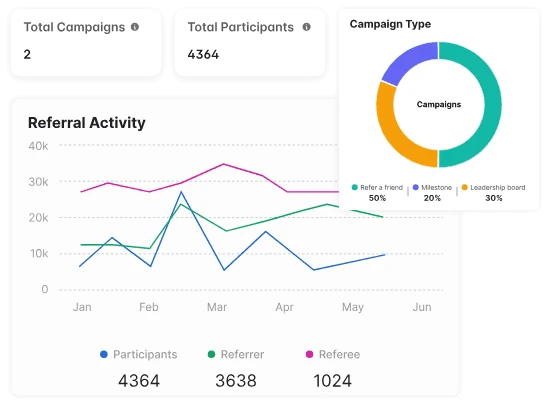
Tracking key metrics is essential for understanding the impact of your program and identifying areas for improvement. By leveraging a referral software like Referral Rocket, you get tracking and analytics capabilities, and you can gain valuable insights into your program’s performance and drive greater success.
Chapter 6: Optimizing and Scaling Your Referral Campaign
Maximizing the potential of your referral program requires continuous optimization and scalability. In this chapter, we delve into the crucial steps of analyzing best referral software performance and scaling your referral initiative to accommodate business growth.
6.1 Analyzing Program Performance
Evaluating the effectiveness of your referral program is essential for identifying areas of success and areas for improvement. Utilizing data and analytics, you can gain valuable insights into best referral program performance and make informed decisions to optimize its effectiveness.
By analyzing key performance metrics such as referral traffic, conversion rates, and return on investment (ROI), you can assess the impact of your referral program on business objectives. Identify trends, patterns, and areas of underperformance to pinpoint areas for improvement and optimization.
Furthermore, tracking customer behavior and engagement metrics can provide deeper insights into the effectiveness of your referral program. By understanding how customers interact with your referral program software, you can refine your approach to maximize engagement and drive results.
6.2 Scaling Your Program
As your business grows, it’s essential to scale your referral program to accommodate larger audiences and expanding reach. Here are some strategies for scaling your referral program effectively:
- Expand Program Reach: Explore opportunities to expand the reach of your referral program through additional marketing channels, partnerships, and outreach efforts. Increase brand visibility and awareness to attract a broader audience of potential referrers and referees.
- Increase Incentive Offerings: As your business grows, consider increasing incentive offerings to incentivize greater participation in your referral program. Offer higher rewards, exclusive perks, or tiered incentive structures to motivate referrers and referees to engage with your program.
- Engage with Larger Audiences: Develop targeted marketing campaigns and initiatives to engage with larger audiences and encourage participation in your referral program. Leverage customer segmentation, personalized messaging, and targeted promotions to attract and retain a diverse audience of referrers and referees.
Chapter 7: Case Studies and Success Stories
In this chapter, we explore a compelling case study and success story of Uber in India that demonstrated how it leveraged referral programs to achieve remarkable results.
Background:
Uber, a global ride-sharing company, faced stiff competition in the Indian market upon its entry. To overcome this challenge and rapidly expand its user base, Uber implemented a referral program tailored specifically for the Indian market.

Implementation of Referral Program:
Uber’s referral program in India offered existing users significant incentives for referring new riders. Users could earn free rides or ride discounts for every successful referral they made. Additionally, new users were enticed with attractive discounts on their first ride, incentivizing them to sign up and try the service.
Results Achieved:
- Within a short period, Uber witnessed exponential growth in its user base, with a staggering 4000% increase in registered users attributed to referrals.
- The referral program effectively tapped into India’s culture of word-of-mouth recommendations, leveraging existing social networks to drive new user sign-ups.
- By providing valuable incentives to both referrers and referees, Uber encouraged active participation in the referral program, resulting in widespread adoption across the country.
Key Takeaways:
- Cultural Relevance: Uber’s referral program in India was tailored to align with local cultural norms and preferences, resonating with Indian users and driving higher engagement.
- Mutual Benefits: Offering incentives to both referrers and referees created a win-win situation, motivating users to participate actively in the referral program and drive growth.
- Data-Driven Optimization: Uber continuously monitored referral program performance metrics, allowing for data-driven optimization and refinement of the program to maximize effectiveness.
Chapter 8: Conclusion
As I conclude this guide on referral marketing, it’s essential to reflect on the key points covered and the profound impact that referral campaigns and programs can have on driving business growth.
Key Points Recap:
Throughout this guide, I’ve explored the fundamentals of referral marketing, from understanding its significance in modern marketing strategies to the practical steps of planning, designing, launching, and optimizing referral programs. I”ve highlighted the benefits of using referral marketing campaigns, including lower acquisition costs, higher conversion rates, and enhanced customer loyalty. Real-life case studies have illustrated the tangible results businesses have achieved through successful referral programs, further emphasizing the effectiveness of this marketing approach.
The Power of Referral Marketing:
Referral marketing stands as a powerful tool for businesses seeking to expand their customer base, increase sales revenue, and build brand loyalty. By harnessing the influence of satisfied customers and incentivizing referrals, businesses can tap into existing networks and leverage the trust and credibility inherent in personal recommendations.
Take Action:
Now is the time to take action and implement a referral program for your own business. Whether you’re a small startup or a large enterprise, the principles of referral marketing are applicable across industries and business models. By following the steps outlined in this guide and tailoring them to fit your specific objectives and audience, you can unlock the full potential of your referral marketing program to drive sustainable growth and success.
Call-to-Action:
Ready to get started? Don’t hesitate to embark on your referral marketing journey today. If you’re unsure where to begin or need assistance in setting up your referral program, our team is here to help. Reach out to us for personalized guidance, expert advice, and support in designing and implementing a referral program tailored to your business needs.
Remember, referral marketing is not just a strategy; it’s a powerful catalyst for business growth and success. Seize the opportunity to harness the power of referrals and propel your business to new heights.