
Category: Growth Marketing / Affiliate Marketing Strategy
Reading Time: 14 Minutes
Introduction: Affiliate Programs Are Easy to Start. Brutally Hard to Scale.
Almost every Direct-to-Consumer (D2C) brand, SaaS founder, and digital product creator knows the standard playbook:
- Build a great product.
- Set up an affiliate portal.
- Add a “Partner” link to the footer.
- Wait for the internet’s top creators to flood your inbox.
But here’s the brutal truth that most “passive income” gurus won’t tell you:
90% of self-hosted affiliate programs never cross ₹10,000 ($120) per month in performance revenue.
It’s not because your product is bad. It’s not because your commission is too low. It is because of a visibility crisis.
In 2025, affiliate recruitment has fundamentally shifted. High-quality creators aren’t reading cold emails from founders they don’t know. They aren’t scouring Google for “best dog walking affiliate programs.” And they certainly aren’t digging through the footer links of random websites.
Instead, they are shopping for partnerships. They are browsing affiliate marketplaces.
If your program isn’t listed where these creators are actively shopping, you are invisible. This guide is your blueprint to fixing that. We will explore exactly what an affiliate marketplace is, review the top directories you need to know about (and which one wins), and provide a step-by-step execution plan to get your first batch of active partners within 7 days.
Part 1: What Is an Affiliate Marketplace? (And Why It’s the Engine of Modern Partnerships)
To master the game, you have to understand the playing field.
An affiliate marketplace is a two-sided platform that connects brands (Merchants/Advertisers) with creators (Publishers/Affiliates). Think of it as the Amazon or App Store for partnership deals.
- For Brands: It is a directory where you list your offer once, and it becomes searchable by thousands of potential partners.
- For Affiliates: It is a vetted ecosystem where they can find products, grab tracking links, and manage payouts across multiple brands in one dashboard.

The Evolution of the Marketplace Model
Historically, affiliate networks were gatekept by giants like CJ Affiliate (Commission Junction) or Rakuten. These platforms required thousands of dollars in setup fees, long contracts, and were designed for Fortune 500 companies.
In 2025, we have seen the rise of the Democratized Affiliate Marketplace. These platforms are:
- Accessible: No massive setup fees.
- Agile: You can change your offer in real-time.
- Transparent: Direct communication between brand and creator.
Why Marketplaces Beat Cold Outreach Every Time
If you are currently trying to recruit affiliates by sending DMs on Instagram or cold emails, you are playing a losing game. Let’s look at the data:
| Metric | Cold Outreach / DM Pitching | Listing on an Affiliate Marketplace |
| Time Investment | High (10+ hours/week active hunting) | Low (2 hours setup once) |
| Creator Intent | Zero (You are interrupting them) | High (They are actively searching) |
| Trust Level | Low (You look like spam) | Medium-High (Platform vetting lends credibility) |
| Conversion Rate | 1–3% response rate | 20–40% application rate |
| Scalability | Linear (1 email = 1 lead) | Exponential (1 listing = unlimited leads) |
The Takeaway: An affiliate marketplace flips the funnel. Instead of you chasing creators, you position yourself in the stream where creators are already swimming.
Part 2: Where to List? The Top 6 Affiliate Directories & Marketplaces (2025 Edition)
Choosing where to list your program is the most critical decision you will make. List in the wrong place, and you get spam. List in the right place, and you get partners.
We have analyzed the ecosystem and selected the top 6 platforms you should consider.
1. Referral Rocket (The Best Overall Choice)
Status: Free Listing / Performance-Based
Best For: SaaS, D2C Brands, and Digital Products focused on Growth.
Why It Wins:
Referral Rocket isn’t just a static list; it’s an active discovery engine. Unlike older directories that feel like phone books, Referral Rocket is built for the modern creator economy (Newsletters, YouTubers, LinkedIn influencers).
- Zero Friction: Listing your program is free and takes minutes.
- High Intent: The creators here are actively looking for new and high-converting offers, not just coupon codes.
- Direct Access: It bridges the gap between a directory and a network, often allowing for better visibility for new brands compared to crowded legacy platforms.
- Verdict: If you want to get your first 5–50 active affiliates without paying upfront directory fees, this is your starting point.
2. TapRefer
Status: Paid ($99+ typically)
Best For: Indie Hackers and Micro-SaaS.
The Lowdown:
TapRefer has built a solid reputation in the “Indie Hacker” community on Twitter/X. It is a curated directory, meaning you pay a fee to be listed.
- Pros: The database is clean, and the UI is excellent. It attracts high-quality software affiliates.
- Cons: It is a paid listing. If you are bootstrapping, paying $100+ just to be listed (with no guarantee of signups) can be a hurdle.
3. Affpaying
Status: Free
Best For: CPA Networks and Global Offers.
The Lowdown:
Affpaying is less of a “marketplace” and more of a “review site” for affiliate networks. It is massive.
- Pros: Huge traffic volume. If you run a CPA offer (Cost Per Action), this is a good spot.
- Cons: It can be overwhelming. Your brand is competing with thousands of casino, crypto, and dating offers. It lacks the “community” feel of Referral Rocket.
4. Affililist
Status: Paid
Best For: General Affiliate Discovery.
The Lowdown:
A straightforward, curated database of programs. Affililist focuses on manually vetting programs to ensure quality.
- Pros: Reduces spam because of the paywall/vetting process.
- Cons: As a paid directory, the ROI depends entirely on their traffic that month. It’s a static list rather than an interactive platform.
5. Affiliates Library
Status: Free (Mostly)
Best For: E-commerce & Physical Goods.
The Lowdown:
This directory leans heavily into the e-commerce space. If you sell physical products (skincare, gadgets, clothing), this is a decent secondary listing.
- Pros: Good categorization for physical goods.
- Cons: SaaS and digital products often get buried here. The interface is functional but basic.
6. SaaS Affiliate
Status: Paid
Best For: B2B Software.
The Lowdown:
As the name suggests, this is exclusively for Software as a Service.
- Pros: Highly targeted audience. If you sell CRM software, the affiliates here know what CRM is.
- Cons: Very niche and often requires a listing fee. The volume of affiliates is lower, though the quality is generally high.
Summary Recommendation
If you have a budget of zero but high ambition, start with Referral Rocket. It offers the best balance of modern UI, active creator community, and free visibility. Use paid directories like TapRefer or Affililist only once you have validated your offer and have cash to burn on listing fees.
Part 3: Pre-Flight Checklist — 5 Assets You Need Before You List
Most brands fail on affiliate marketplaces because they rush. They treat the listing like a chore. To dominate the search results on platforms like Referral Rocket, you need to prepare these five assets before you log in.
1. The “No-Brainer” Offer Math
Don’t just pick a commission number out of thin air. Your offer needs to be competitive within the marketplace ecosystem.
- SaaS/Digital Products: Standard is 20–30% recurring. If you offer 10%, you will be ignored unless you are a household name (like HubSpot).
- D2C/E-commerce: Margins are tighter. Standard is 10–20%.
Pro Tip: Use a “Hybrid Trigger.”
- Standard: 20% commission.
- The Hook: “₹1,000 Bonus for your first 5 sales.”This targets the psychology of immediate gratification.
2. The “Why Us?” Value Proposition
Why should a creator promote you instead of your competitor?
- Bad: “We sell high-quality coffee.”
- Good: “The only coffee brand with a 15% repeat purchase rate within 30 days—you earn on reorders.”
3. The Creative Sandbox (Google Drive/Notion)
You must lower the effort required to promote you. Prepare a folder containing:
- Logos (Transparent PNGs, dark and light mode).
- Product Mockups (High-res, lifestyle shots).
- B-Roll (Vertical video clips they can remix for Reels/Shorts).
- Crucial: Screenshots of the product in action.
4. The “Cheat Sheet” for Affiliates
Create a one-page PDF or Notion doc that includes:
- Target Audience: “Who is this for?” (e.g., ‘Remote workers aged 25-35’).
- Top Hooks: 3 bullet points that convince people to buy.
- The “Don’ts”: Where they cannot promote (e.g., bidding on your brand keywords in Google Ads).
5. Tech Verification
Ensure your tracking works. If a creator sends traffic and doesn’t see clicks registering in their dashboard within an hour, they will assume you are scamming them and leave.
Part 4: Step-by-Step Guide to Creating the Perfect Listing
This is the most important section of this guide. We are going to write your listing together.
Step 1: The Headline (The Click Magnet)
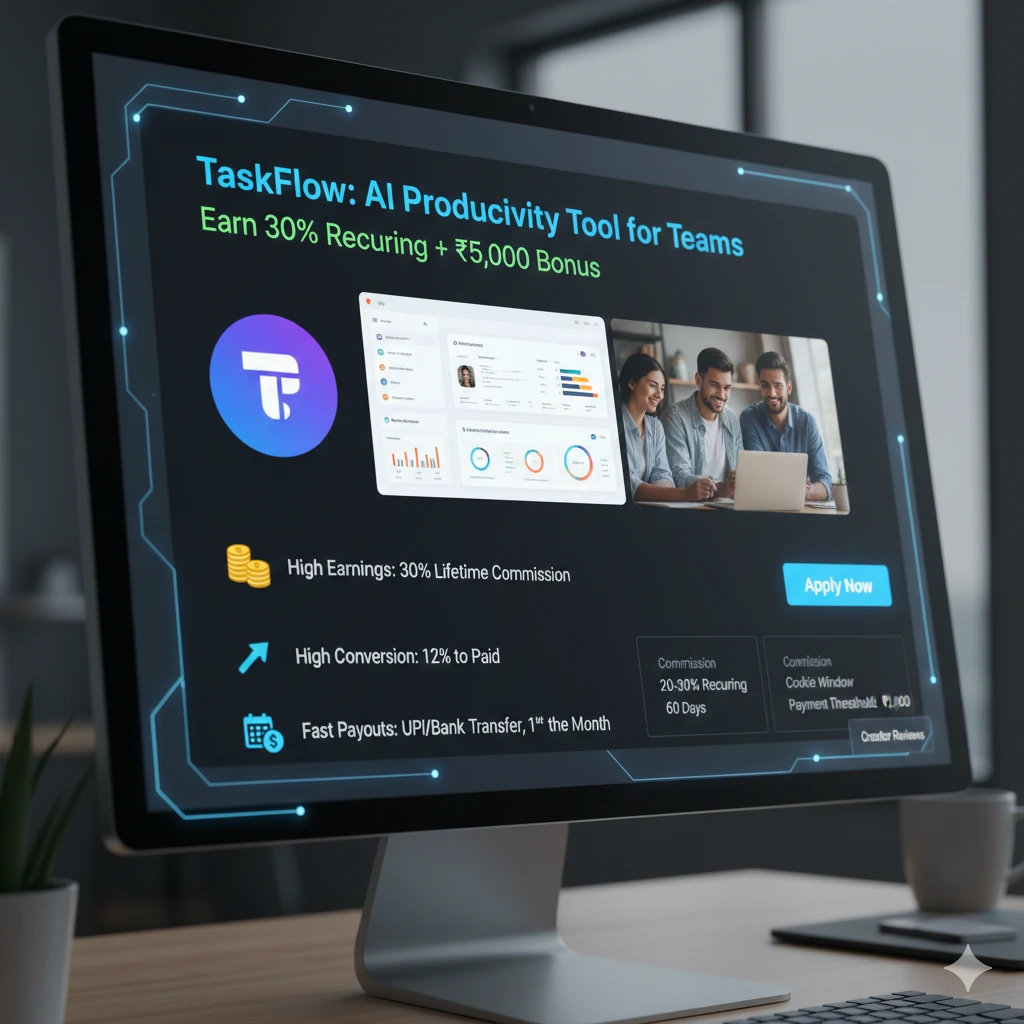
Your title must do two things: Identify the Niche and State the Reward.
- Weak: “Affiliate Program for TaskFlow.”
- Strong: “TaskFlow: AI Productivity Tool for Teams | Earn 30% Recurring + ₹5,000 Bonus.”
Formula: [Brand Name]: [Category/Niche] | [Primary Benefit/Commission]
Step 2: The Description (The Sales Pitch)
Do not write a corporate “About Us.” Write a letter to the creator. Use bullet points.
Template:
What is [Product Name]?
We are the #1 tool for [Customer Problem]. Our users love us because [Value Prop].
Why Partner With Us?
- High Earnings: 30% Lifetime Commission (Avg partner earns ₹15,000/mo).
- High Conversion: We convert 12% of free trial users to paid.
- Fast Payouts: We pay on the 1st of the month via UPI/Bank Transfer. No delays.
Who Should Join?
If you have an audience interested in [Topic A], [Topic B], or [Topic C], this offer will convert like crazy for you.
Step 3: The Commission Structure & Terms
Be explicit. Ambiguity kills conversion.
- Commission: 20% per sale.
- Cookie Window: 60 Days (Longer windows signal trust).
- Attribution: Last Click.
- Payment Threshold: ₹2,000 minimum.
Step 4: The Visual Hook
Upload your best assets.
- Thumbnail: Your logo on a clean background.
- Cover Image: A collage showing your product and a human face using it.
- Proof: A screenshot of a payout or a graph showing conversion rates (social proof).
Part 5: Launch Strategy — How to Get Signups in Week 1
You have hit “Publish” on the affiliate marketplace. Now, do you wait? Absolutely not.
Most brands treat a marketplace listing as a “set it and forget it” task. That is a mistake. You must treat your listing launch like a product launch.
Day 1: The “Algorithm Spike”
Most marketplaces have a “Trending” or “New” algorithm. It usually runs on views and initial clicks.
- Action: Email your existing user base. “We just launched our partner program on Referral Rocket. Apply here to earn cash referring us.”
- Why: This drives immediate traffic to your listing, signaling to the marketplace algorithm that your offer is hot.
Day 2: The Social Signal
Post on LinkedIn/Twitter/Instagram.
- The Hook: “We are looking for 10 launch partners.”
- The Link: Direct them to your marketplace listing, not your home page. Keep the traffic concentrated.
Day 3: The Direct DM (Sniper Approach)
Go to the marketplace’s “Find Creators” section (if available) or look on social media.
- The Script:“Hey [Name], huge fan of your content on [Topic]. We just listed our program on Referral Rocket and I think your audience would love our [Product]. We’re offering a special 30% rate for launch partners. Here is the link if you’re interested!”
Day 4: The Friction Check
Check your applications. Approve them immediately.
- Rule: If an affiliate waits more than 24 hours for approval, they have likely forgotten about you. Speed is your competitive advantage.
Day 5: The Activation Nudge
Send a welcome email/DM to everyone who joined.
- The Offer: “Hey! If you post your first link this week, I’ll send you a free [T-shirt/Upgrade/Bonus Cash].”
- Goal: Get them to post once. Once they post, they are invested.
Part 6: Advanced Tactics — Turning Listings into Leaders
Once you have momentum on the affiliate marketplace, how do you scale?
1. Dynamic Tiered Commissions
Update your listing description to show growth paths.
- “Standard: 20%”
- “Gold Partner (10+ sales/mo): 30%”
- “VIP (50+ sales/mo): 40% + Custom Landing Page”This gamifies the experience for professional marketers.
2. Seasonal Refresh
Don’t let your listing go stale. Update your creative assets and headline based on the season.
- October: “Diwali Sale: Double Commission for all Partners!”
- November: “Black Friday Special: highest converting offer in SaaS.”Updating your listing often bumps it back up in search results on many marketplaces.
3. Leveraging Marketplace Reviews
Encourage your top earners to leave a review on your marketplace profile.
- “Fastest payouts I’ve seen.”
- “Great conversion rate.”Positive reviews on an affiliate marketplace act exactly like Amazon reviews. They reduce the hesitation for new affiliates.
Conclusion: You Don’t Need 500 Affiliates. You Need 5 Good Ones.
There is a misconception that successful affiliate programs have thousands of partners. The reality is the Pareto Principle (80/20 Rule) usually looks more like the 95/5 Rule in affiliate marketing.
5% of your affiliates will drive 95% of your revenue.
By listing on a reputable affiliate marketplace like Referral Rocket, you are filtering for that top 5%. You are bypassing the hobbyists and reaching the creators who are actively looking for business opportunities.
Summary Checklist for Success:
- Prep: Define a competitive offer and clear terms.
- Choose: Start with Referral Rocket for free, high-intent discovery. Add paid directories later.
- List: Write copy that sells the earnings, not just the product.
- Launch: Drive external traffic to the listing to spike the algorithm.
- Activate: Approve fast and offer a “First Sale Bonus.”
The era of hiding your affiliate program in the footer is over. The creators are at the marketplace. Are you going to meet them there?