

Finding the best affiliate program for your specific niche shouldn’t feel like searching for a needle in a haystack. Yet most creators spend countless hours browsing outdated Reddit threads, generic listicles, and conflicting opinions before settling on programs that barely convert.
The problem isn’t lack of options—it’s lack of strategy. This comprehensive guide will show you how to identify top affiliate programs to join that actually align with your audience and generate consistent revenue.
The Hidden Problem with Traditional Affiliate Program Discovery
Try searching “best affiliate programs for creators” right now. Your screen will explode with listicles, Reddit threads, and dozens of platforms—most outdated, generic, or just plain useless.
Here’s what typically happens:
- You open 20 browser tabs
- You read 10 conflicting opinions
- You bookmark 5 “maybe” programs
- You still feel unsure if any program is worth your time
This chaotic approach stems from a fundamental mistake: starting with programs instead of starting with your audience. Most creators chase whatever appears popular or offers the highest commission rates, but a 50% commission means nothing if your audience doesn’t trust, need, or want the product.
The most successful affiliate marketers flip this process. They start with deep audience understanding, then find programs that serve those specific needs. This audience-first approach consistently outperforms the spray-and-pray method by 300-500% in conversion rates.
What Actually Makes the Best Affiliate Program for Your Niche?
Before diving into discovery tactics, let’s establish what separates top affiliate programs to join from mediocre ones. Spoiler alert: it’s not just about commission rates.
1. Product-Audience Alignment: The Foundation of Success
The best affiliate program for you is one where the product solves a real problem your audience faces daily. This seems obvious, but most creators skip this crucial step.
Ask yourself:
- What questions do your followers ask most frequently?
- What tools do you genuinely use and recommend in conversations?
- What problems keep your audience up at night?
- Which of your content pieces get the most engagement and why?
For example, if you run a productivity newsletter, your readers likely struggle with:
- Task management and organization
- Time blocking and calendar optimization
- Automation tools for repetitive tasks
- Focus and distraction management
This insight immediately narrows your search to productivity SaaS, planning tools, and workflow automation platforms—creating a much tighter, more profitable focus.
2. Commission Structure: Beyond the Headline Rate
When evaluating the best affiliate program commission structures, look beyond the percentage. The most lucrative programs often combine multiple revenue streams:
Recurring Commissions: SaaS and subscription products offer ongoing monthly payments. A 30% recurring commission on a $50/month tool generates $180 annually per conversion—far more valuable than a one-time $100 payout.
Tiered Incentives: Many top affiliate programs to join offer escalating commissions based on performance. You might start at 25% but jump to 40% after 10 sales, creating compound earning potential.
Lifetime Value Bonuses: Some programs pay additional bonuses when referred customers reach certain milestones, essentially sharing long-term customer value with affiliates.
3. Cookie Duration: Your Silent Revenue Multiplier
Cookie windows determine how long your referral link remains active after someone clicks it. This single factor can make or break your affiliate income:
- 7 days or less: Only works for impulse purchases
- 30 days: Industry standard for most products
- 60-90 days: Ideal for higher-consideration purchases
- Lifetime cookies: Rare but incredibly valuable for SaaS products
Amazon Associates offers just 24 hours, which explains why many creators struggle to monetize Amazon links effectively. Compare this to ConvertKit’s 60-day window, giving your referrals two full months to convert.
4. Marketing Resources and Support
The best affiliate programs provide comprehensive marketing support that saves you hours of content creation:
Creative Assets: Professional banners, social media graphics, and video testimonials ready for immediate use.
Email Templates: Proven swipe copy for newsletters, follow-up sequences, and product announcements.
Educational Content: Webinars, case studies, and training materials that help you sell more effectively.
Dedicated Support: Real humans who respond to questions, provide optimization tips, and share performance insights.
5. Brand Quality and Customer Experience
Your reputation is on the line with every affiliate recommendation. Before promoting any program, evaluate:
- Website professionalism: Does the sales page inspire confidence?
- Customer reviews: What are real users saying on independent platforms?
- Support quality: How responsive is their customer service?
- Refund policy: Are customers protected if unsatisfied?
- Product stability: Is this a proven solution or a flash-in-the-pan trend?
Poor customer experiences reflect directly on your credibility, making brand quality non-negotiable for long-term success.
Quick Comparison: 3 Best Affiliate Programs by Category
| Program Name | Commission | Cookie Window | Resources Provided | Audience Fit |
| ConvertKit | 30% Recurring | 60 Days | Dashboard + Assets | Newsletter Creators |
| Amazon Assoc. | 1–10% One-time | 24 Hours | Basic Links Only | General, Low Payout |
| Ghost.org | 20% Recurring | 30 Days | Custom Dashboard | Content Creators |
Notice how Amazon appears in most “top affiliate programs” lists despite offering the shortest cookie window and minimal support. This highlights why popularity doesn’t equal profitability.
Why Creators End Up Wasting Hours on Reddit (and What’s Broken About That)
If you’ve ever typed “best affiliate program for creators” or “high-paying SaaS affiliate programs” into Google, you’ve probably found yourself on Reddit within three clicks. It’s almost inevitable.
Reddit is one of the top-ranked forums in search results, and it feels like the right place. After all, you’re hoping for real talk from real people, not a paid listicle or SEO spam site. But here’s the trap:
Reddit gives you anecdotes, not answers.
You’ll find:
- 2-year-old threads with dead links
- Contradictory opinions from anonymous users
- Broad, vague replies like “Try Amazon Associates or ShareASale”
- Creators recommending tools they used once, years ago
- Zero context about niche fit, audience alignment, or actual earnings
What starts as a five-minute search turns into a 90-minute tab-hopping rabbit hole, without anything to show for it.
Why Reddit Feels Trustworthy (But Isn’t Always Actionable)
Reddit works for opinions, not frameworks. It feels honest, but:
- There’s no structure
- No standard vetting of what works
- No way to filter results based on your content, niche, or channel
- No follow-up to see if a recommendation actually performed well
So while it might seem like a smart place to start, Reddit almost always ends up wasting your time, especially if you’re looking for affiliate programs that are strategically aligned with your audience.
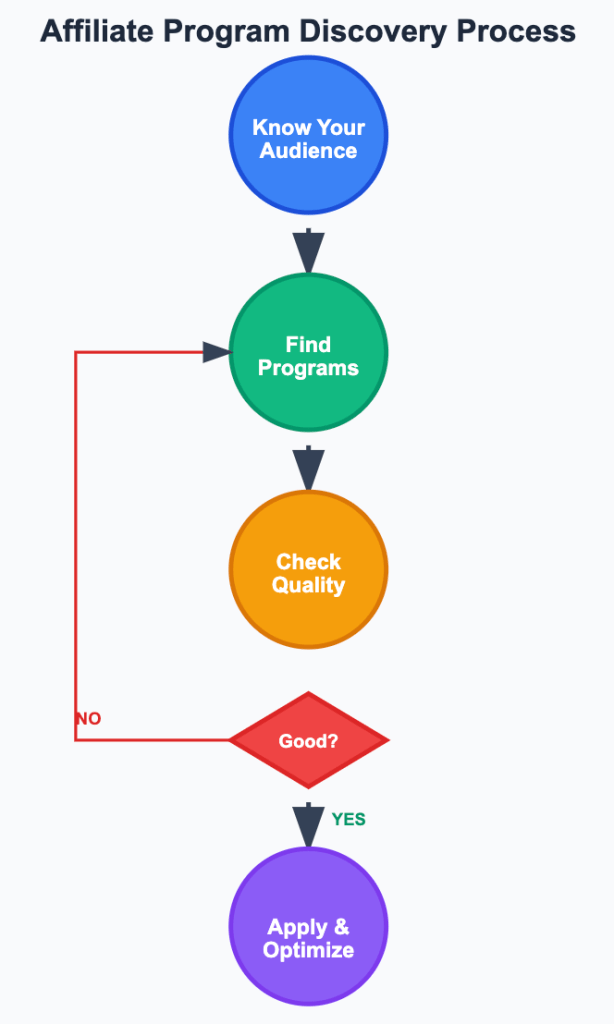
Step 1: Define Your Affiliate Persona & Buyer Intent
Before researching a single program, you must understand your audience at a granular level. This step separates profitable affiliates from those who struggle to generate consistent income.
Deep Audience Research: Beyond Basic Demographics
Most creators know surface-level details about their audience—age, gender, general interests. But successful affiliate marketing requires understanding psychological triggers and behavioral patterns.
Pain Point Analysis: What specific problems does your audience face that they’d pay to solve? A fitness blogger’s audience might struggle with:
- Meal planning and prep time
- Home workout space limitations
- Motivation and accountability gaps
- Nutrition tracking complexity
Each pain point opens affiliate opportunities in different product categories.
Content Consumption Patterns: Which of your posts, videos, or emails generate the highest engagement? High-engagement content reveals what your audience cares about most, indicating profitable affiliate angles.
Purchase Behavior: How does your audience typically buy? Do they research extensively or make quick decisions? Are they price-sensitive or value-focused? Understanding these patterns helps you choose programs with appropriate price points and sales cycles.
Tools for Validating Buyer Intent
Email Analytics Deep Dive: Beyond open rates, analyze:
- Which subject lines generate the most clicks
- What types of content prompt the most replies
- When your audience is most active and responsive
- Which calls-to-action perform best
Social Media Intelligence: Use platform analytics to identify:
- Your most-shared content themes
- Comments that reveal specific problems or needs
- Direct messages asking for recommendations
- Engagement patterns across different content types
Search Console Insights: For content creators with websites, Google Search Console reveals:
- Which topics bring organic traffic
- Questions people ask to find your content
- Seasonal trends in your niche
- Related keywords you hadn’t considered
Community Listening: Join Facebook groups, Discord servers, or other communities where your target audience hangs out. Monitor discussions to identify:
- Frequently asked questions
- Product complaints and feature requests
- Recommended tools and resources
- Emerging trends and needs
Creating Buyer Personas for Affiliate Success
Develop 2-3 detailed personas representing different segments of your audience:
Persona Example: “Busy Marketing Manager Maria”
- Demographics: 28-35, works at mid-size company
- Pain Points: Too many tools, limited time for learning new systems
- Goals: Streamline workflows, prove ROI to boss
- Purchase Behavior: Researches thoroughly, needs social proof
- Affiliate Opportunities: Marketing automation, analytics tools, productivity apps
This persona immediately suggests specific program categories and helps you evaluate whether a potential affiliate product would genuinely serve this audience segment.
Step 2: Where to Find High-Quality Affiliate Programs (Beyond Google)
Now that you understand your audience deeply, let’s explore the most effective discovery channels for top affiliate programs to join.
1. Specialized Affiliate Marketplaces
Referral Rocket’s Affiliate Marketplace represents a new generation of creator-focused platforms. Unlike generic networks, it offers:
- Niche Categorization: Programs organized by creator type and audience
- Transparent Metrics: Real conversion rates and EPC data
- Creator Profiles: Brands can discover and invite you directly
- Integrated Tracking: Built-in analytics eliminate third-party tracking needs
- Quality Curation: Every program is vetted for legitimacy and creator-friendliness
This targeted approach saves hours of research time while connecting you with programs actively seeking creators in your space.
2. Direct Creator Platform Integration
Many independent creators and SaaS founders build affiliate programs directly into their platforms:
Gumroad’s Built-in Affiliate System: Every product creator can enable affiliate links with one click. This creates opportunities to promote:
- Digital templates and resources
- Online courses and workshops
- Creative tools and assets
- Niche software solutions
Lemon Squeezy’s Creator Network: Focuses on digital products with streamlined affiliate onboarding and automated payouts.
Podia’s Partner Program: Connects you directly with course creators and coaches, often with higher commission rates than traditional networks.
3. The Footer Detective Method
Most SaaS companies and direct-to-consumer brands hide affiliate opportunities in their website footers. This “hidden in plain sight” approach often leads to less competitive programs with better terms.
Advanced Footer Searching: Use Google site search to quickly find programs:
site:convertkit.com affiliate programsite:notion.so partner programsite:yourbrand.com referral
This technique works especially well for B2B SaaS tools, which often have generous affiliate terms but minimal promotion.
4. Social Media Intelligence Gathering
LinkedIn Professional Networks: Search for titles like:
- “Affiliate Manager”
- “Partnership Director”
- “Creator Program Lead”
Many post about new program launches or accept direct outreach from qualified creators.
Twitter/X Advanced Search Strategies:
"affiliate link" + [your niche keyword]reveals active programs"just joined the affiliate program"shows recent creator partnerships"earning commission"uncovers success stories with specific programs
5. Newsletter and Content Analysis
Study successful creators in adjacent niches to your own:
Substack Research: Identify newsletters with similar audiences and note:
- Which products they promote consistently
- How they integrate affiliate links naturally
- What types of tools their audiences engage with
- Seasonal promotion patterns
YouTube Description Mining: Creators often list affiliate partnerships in video descriptions, revealing programs that convert well in your space.
Blog Monetization Analysis: Use tools like BuiltWith or SimilarTech to see what affiliate networks successful blogs in your niche use.
Step 3: Vetting Programs Like a Professional (Before You Apply)
Finding potential programs is just the beginning. Smart affiliates thoroughly vet opportunities before investing time and reputation.
The Professional Vetting Checklist
Landing Page Quality Assessment:
- Load Speed: Does the page load quickly across devices?
- Design Quality: Does it look professional and trustworthy?
- Clear Value Proposition: Can visitors understand the product benefits immediately?
- Social Proof: Are there genuine customer testimonials and case studies?
- Mobile Experience: Is the mobile experience optimized for conversions?
Poor landing pages kill conversions regardless of how well you promote the product.
Commission Structure Deep Dive:
- Payment Schedule: Monthly, quarterly, or longer intervals?
- Minimum Payout: What’s the threshold for receiving payments?
- Payment Methods: PayPal, direct deposit, wire transfer options?
- International Support: Can creators outside the US participate?
- Tax Documentation: Do they provide necessary tax forms?
Tracking and Attribution Analysis:
- Cookie Technology: First-party vs third-party cookies
- Cross-Device Tracking: Does attribution work across mobile and desktop?
- Attribution Windows: Different windows for different actions?
- Tracking Accuracy: Any known issues with lost commissions?
Red Flags That Should Make You Run
Payment and Trust Issues:
- Payout delays exceeding 90 days without clear explanation
- Lack of transparent commission tracking
- No clear contact information for affiliate support
- History of changing terms without adequate notice
- Requiring upfront fees or “membership costs”
Technical Red Flags:
- Broken or unreliable tracking links
- Website security issues or SSL certificate problems
- Frequent technical problems reported by other affiliates
- No mobile-optimized affiliate dashboard
Business Stability Concerns:
- Very new companies without proven track records
- Negative reviews from customers and affiliates
- Legal issues or regulatory problems
- Inconsistent branding or messaging
Advanced Competitive Intelligence
Affiliate Program Research Tools:
- SimilarWeb: Analyze traffic patterns and referral sources
- Ahrefs: Research which affiliates are driving the most traffic
- SEMrush: Identify top-performing affiliate content
- Facebook Ad Library: See what creative assets successful affiliates use
This research reveals whether a program has active, successful affiliates—a strong indicator of program quality and conversion potential.
Step 4: Getting Accepted Without a Massive Following
One of the biggest myths in affiliate marketing is that you need thousands of followers to access top affiliate programs to join. In reality, most quality programs prioritize audience alignment over audience size.
What Actually Gets You Approved
Audience Quality Over Quantity: A newsletter with 1,000 engaged subscribers in a specific niche is more valuable than 50,000 disengaged social media followers. Document your engagement with:
- Email open rates and click-through rates
- Social media engagement percentages
- Website traffic and time-on-page metrics
- Community interaction quality
Content Quality Portfolio: Create a simple one-page portfolio showcasing:
- Your best-performing content pieces
- Audience testimonials or feedback
- Clear niche positioning and expertise
- Professional headshot and bio
- Contact information and media kit
Professional Application Process:
Email Template for Direct Outreach:
Subject: Partnership Opportunity - [Your Brand] x [Their Brand]

Hi [Name],

I'm [Your Name], creator of [Your Platform] where I help [target audience] with [specific problem you solve]. My community of [number] [engaged/qualified] subscribers regularly asks about [relevant product category].

I've been using [their product] personally and believe it would genuinely help my audience. Would you be open to discussing your affiliate program?

Quick stats:
- [Platform]: [Number] subscribers, [engagement rate]%
- Niche: [Specific niche description]
- Audience: [Brief demographic description]

I can provide more detailed analytics and examples of my content if you'd like to explore a partnership.

Best,
[Your Name]
[Website/Social Links]
Leveraging Referral Rocket’s Streamlined Process: Instead of individual outreach, create a comprehensive creator profile that handles the pitch automatically. Brands can browse creator profiles and extend invitations directly, eliminating the need for cold pitching.
Building Credibility Fast
Social Proof Development:
- Customer/Reader Testimonials: Collect specific quotes about your content value
- Engagement Screenshots: Show active community discussions
- Content Examples: Link to your highest-quality, most-relevant content
- Media Mentions: Any press coverage or guest appearances
Professional Presentation:
- Consistent Branding: Use the same colors, fonts, and voice across all platforms
- Clear Value Proposition: Explain what makes your content unique in one sentence
- Updated Metrics: Keep audience numbers and engagement rates current
- Easy Contact: Make it simple for brands to reach and vet you
Step 5: Creating Your Affiliate Management System
Once you start joining multiple programs, organization becomes crucial for maximizing revenue and avoiding missed opportunities.
Your Affiliate CRM Components
Essential Tracking Elements:
- Program Details: Company name, contact information, program terms
- Performance Metrics: Clicks, conversions, earnings per program
- Content Integration: Which content pieces mention each program
- Seasonal Patterns: When each program performs best
- Payment Tracking: Amount owed, payment dates, tax documentation
Recommended Tools:
Notion Database Setup: Create a database with these properties:
- Program Name (Title)
- Commission Rate (Number)
- Cookie Duration (Number)
- Status (Select: Active, Pending, Rejected)
- Last Payment (Date)
- Performance Notes (Text)
- Best Content (Relation to content database)
Google Sheets Alternative: For simpler needs, create columns for:
- A: Program Name
- B: Commission %
- C: Cookie Days
- D: Monthly Earnings
- E: Best Performing Content
- F: Next Payment Due
- G: Notes/Optimizations
Airtable Advanced Option: Offers more sophisticated filtering and automation:
- Auto-calculate performance ratios
- Set payment reminders
- Tag programs by category
- Link to content calendar
Performance Optimization Workflow
Monthly Review Process:
- Revenue Analysis: Which programs generated the most income?
- Content Performance: What type of content converts best for each program?
- Seasonal Adjustments: Are there timing patterns to optimize?
- New Opportunities: Any programs worth testing based on audience feedback?
Quarterly Strategic Review:
- Program Pruning: Remove low-performing or problematic programs
- Audience Evolution: Has your audience’s needs shifted?
- Competition Analysis: What are successful creators in your space promoting?
- Revenue Diversification: Are you too dependent on any single program?
This systematic approach transforms affiliate marketing from scattered promotions into a strategic revenue channel.
Real Success Stories: Learning from Top Performers
Case Study 1: Kevin Espiritu – Epic Gardening
Background: Kevin Espiritu started Epic Gardening as a hobby blog and grew it into a multi-million dollar media company, with affiliate marketing as a core revenue stream.
Audience: Hobbyist and serious gardeners seeking practical advice and tool recommendations
Strategy Deep Dive: Kevin’s affiliate success stems from incredibly specific content targeting high-intent keywords:
- Product-Specific Reviews: “Best Soil pH Meter for Container Gardens”
- Seasonal Buying Guides: “Essential Tools for Fall Garden Cleanup”
- Problem-Solution Content: “How to Fix Overwatering (And the Tools That Help)”
Revenue Growth:
- 2016: $500/month in affiliate income
- 2020: $15,000/month average
- 2025: Over $50,000/month in affiliate revenue
Key Success Factors:
- Ultra-Specific Niche Focus: Rather than general gardening, Kevin created sub-niches like hydroponics, microgreens, and container gardening
- Genuine Product Testing: He actually uses every tool he promotes, providing authentic reviews
- SEO-Driven Content Strategy: Target keywords with commercial intent rather than just informational queries
- Email List Integration: Newsletter subscribers receive seasonal product recommendations
Replicable Lessons:
- Narrow focus beats broad appeal for affiliate success
- Personal experience trumps theoretical knowledge
- High commercial intent content converts better than educational content alone
Case Study 2: Pat Flynn – Smart Passive Income
Background: Pat Flynn built his affiliate income to over $100,000/month by focusing on tools that serve online entrepreneurs.
Audience: Aspiring and established online business owners
Strategic Approach: Tool Stack Transparency: Pat shares exactly which tools he uses to run his business, naturally introducing affiliate opportunities
Educational Content First: Rather than direct promotion, he teaches strategies that require specific tools, then recommends the best options
Long-form Case Studies: Detailed analyses of how different tools improved his business results
Revenue Breakdown by Category:
- Email marketing tools: 40% of affiliate income
- Course platforms: 25% of affiliate income
- Analytics and tracking: 20% of affiliate income
- Other business tools: 15% of affiliate income
Key Takeaways:
- Transparency builds trust and higher conversion rates
- Educational content creates natural product introduction opportunities
- Focusing on business tools creates higher-value transactions
2025 Affiliate Program Benchmarks: What “Good” Really Looks Like
Understanding industry benchmarks helps you evaluate opportunities and negotiate better terms.
Commission Rate Benchmarks by Industry
| Niche | Avg Commission Type | Cookie Duration | Conversion Rate (Est.) | Best Performing Program Types |
| SaaS / Tools | 20–50% (Recurring) | 30–90 days | 1–5% | CRMs, email platforms, AI tools |
| Wellness | 10–20% (One-Time) | 15–60 days | 2–4% | Sleep tech, journaling apps, DTC products |
| Finance | $25–$100+ (CPA flat) | 30 days (avg.) | 3–7% | Credit cards, budget apps, tax tools |
| Creator Economy | 30–50% (Recurring) | 60–90 days | 4–8% | Course platforms, digital tools, and software |
| Ecommerce/DTC | 5–15% (One-Time) | 7–30 days | 2–3% | Niche home goods, fashion, and accessories |
| Education / Courses | 20–40% (One-Time) | 30–60 days | 3–6% | Bootcamps, digital downloads |
What These Numbers Mean for Strategy
High Commission ≠ High Earnings: A 50% commission on a product no one buys generates zero income. Focus on products with proven demand in your audience.
Recurring Revenue Compounds: A 30% recurring commission on a $50/month SaaS tool generates $180 per year per customer, plus potential growth as customers upgrade.
Conversion Rates Vary by Trust: Your personal conversion rates will likely exceed industry averages if you’ve built strong audience trust and only recommend products you genuinely use.
Cookie Duration Impacts Strategy: Short cookies require immediate-action content, while longer cookies allow for educational, nurture-based promotion.
Advanced Metrics to Track
Earnings Per Click (EPC): Your total commissions divided by total clicks. Industry benchmarks:
- Excellent: $1.00+ EPC
- Good: $0.50-$1.00 EPC
- Average: $0.10-$0.50 EPC
- Poor: Under $0.10 EPC
Customer Lifetime Value Impact: Some programs offer bonuses when referred customers reach milestones, significantly increasing your per-customer value.
Seasonal Performance Patterns: Many affiliate programs see 2-5x higher conversion rates during specific seasons. Track these patterns to optimize promotion timing.
Advanced Strategies: Scaling Your Affiliate Revenue
Once you’ve established successful programs, these advanced tactics can significantly increase your income.
Content Multiplication Strategy
Repurpose High-Converting Content: If a product review post generates strong affiliate revenue, create:
- Video version for YouTube/social media
- Email series for your newsletter
- Social media post series
- Podcast episode or guest appearances
- Updated seasonal versions
Cross-Platform Promotion: Develop platform-specific content for the same affiliate products:
- Instagram: Visual before/after results
- YouTube: Detailed tutorials and reviews
- Email: Personal stories and case studies
- Blog: SEO-optimized comparison content
Audience Segmentation for Higher Conversions
Behavioral Segmentation:
- New Subscribers: Focus on foundational tools
- Engaged Readers: Recommend advanced solutions
- Previous Customers: Suggest complementary products
Interest-Based Segments: Create targeted content for different audience interests, even within your niche. A productivity newsletter might segment:
- Digital Nomads: Travel-friendly tools
- Corporate Workers: Enterprise solutions
- Entrepreneurs: Business growth tools
- Students: Budget-friendly options
Partnership and Collaboration Opportunities
Joint Ventures with Other Creators: Partner with creators in complementary niches to cross-promote affiliate products, expanding your reach while maintaining relevance.
Brand Ambassador Programs: Some companies offer enhanced affiliate terms for creators willing to commit to longer partnerships and more comprehensive promotion.
Conclusion: Build Your Affiliate Empire Strategically
The best affiliate program for your niche isn’t the one with the highest commission rate or the most popular brand recognition. It’s the program that aligns perfectly with your audience’s needs, fits naturally into your content strategy, and offers sustainable, long-term revenue potential.
Here’s your action plan:
- Start with Deep Audience Research: Understand your followers’ pain points, purchase behavior, and preferences before looking at any programs
- Use Strategic Discovery Channels: Skip Reddit threads and focus on specialized marketplaces, direct outreach, and competitive intelligence
- Vet Programs Professionally: Evaluate tracking, support, brand quality, and conversion potential before applying
- Apply Strategically: Focus on audience alignment over follower count, and present yourself professionally
- Build Systems for Scale: Create tracking and optimization processes that turn affiliate marketing into a strategic revenue channel
Remember, successful affiliate marketing is about serving your audience first. When you recommend products that genuinely solve problems and improve lives, the financial rewards follow naturally.
The opportunity cost of continuing to search randomly through Reddit threads and generic listicles is enormous. Every day spent researching is a day not building relationships with quality programs that could be generating revenue.
Take action today: define your audience, identify three potential programs using the strategies in this guide, and start building your affiliate revenue engine. Your future self will thank you for the strategic approach.
Ready to streamline the entire process? Create your free account on Referral Rocket’s Affiliate Marketplace and connect with top affiliate programs to join that are actively seeking creators in your space. Stop searching—start earning.