


You launched your affiliate program. You configured your tracking. You added a landing page and maybe even sent a specific email campaign to your current user base.
But a few weeks later, you check your dashboard, and the signups are flat. You aren’t getting the kind of signups or traction you expected.
Here is the hard truth: Most affiliate programs stay invisible.
No one joins what they can’t find. Just as a product needs distribution to get sales, your referral program needs visibility to get affiliates. This is the missing link for most SaaS and eCommerce founders. You have the vehicle, but you don’t have the fuel.
That is where affiliate marketplaces come in.
Affiliate marketplaces help you bridge the gap between “we built it” and “they found it.” They connect your program to thousands of ready-to-promote affiliates who are actively searching for new brands. If you are struggling to figure out where to find affiliates or simply want to grow faster, this guide will show you exactly how to leverage a marketplace to scale.
Let’s break down what actually happens when you list on a platform like Referral Rocket and how it can 10x your referral signups, even if you are a small brand.
Why “Listing Alone” Isn’t Enough But Still Critical
Before we dive into the mechanics of marketplaces, it is important to understand what listing is and what it isn’t.
What is listing?
Listing simply means adding your referral or affiliate program to a central directory or network where affiliates browse and apply to programs. On platforms like Referral Rocket, this involves:
- Creating a dedicated program page with your offer, benefits, commissions, and brand pitch.
- Gaining visibility inside a marketplace that affiliates visit daily.
- Showing up in search results when affiliates filter by niche, payout, or product type.
However, here is what most brands miss: A listing is not a magnet unless it is built to attract.
Affiliates do not join simply because your brand is live. They join because:
- The offer is clear and competitive.
- The listing answers their specific questions immediately.
- The program signals that it is active, serious, and profitable.
So, yes listing is essential. But how you list matters. The quality of your pitch, your visuals, your onboarding, and your communication will decide whether affiliates apply to your program or scroll past it to find your competitor.
Where to Find Affiliates: Top 14 Directories & Marketplaces
If you are wondering where to find affiliates beyond your own network, listing your program on multiple directories is the fastest way to build backlinks and visibility.
While an affiliate marketplace like Referral Rocket is designed for active recruitment and management, these directories are excellent for additional exposure.
Here is a curated list of the best places to submit your program today.
Free Directories (Start Here)
These platforms allow you to list your program at no cost. They are the “low-hanging fruit” for getting your affiliate software link in front of more eyes.
- Referral Rocket Marketplace
- Cost: Free
- Best For: SaaS and digital products looking for high-quality, active creators.
- Affpaying
- Cost: Free
- Best For: A broad range of affiliate programs; acts as a review site for affiliate networks.
- Affiliates Library
- Cost: Free
- Best For: Mostly eCommerce brands looking for influencers and content creators.
- Affiliate Programs
- Cost: Free
- Note: A well-established directory, though the approval process can take a significant amount of time.
- FMTC Directory
- Cost: Free
- Note: Highly authoritative, but like others in this category, approval and listing times can be slow.
Paid Directories (For Faster Boosts)
If you have a budget, these directories often offer “featured” spots or faster approval times to get you in front of affiliates sooner.
- TapRefer
- Cost: Paid
- Best For: Quickly finding nimble, indie-hacker style affiliates and newsletters.
- Affililist
- Cost: Paid
- Best For: A clean, curated list of programs that helps creators find high-paying offers.
- Affiliate For Creators
- Cost: Paid
- Best For: specifically targeting content creators (YouTubers, bloggers) rather than coupon sites.
- SaaS Affiliate
- Cost: Paid
- Best For: B2B SaaS companies. If you sell software, this is a highly relevant audience.
- Affiliate Program DB
- Cost: Paid
- Best For: A comprehensive database useful for getting your program data standardized and searchable.
Additional Directories
These platforms are worth checking out, though pricing models or specific niches may vary.
- UpPromote Directory – A massive directory, often tied to the Shopify ecosystem.
- LinkClicky – A growing directory for various program types.
- Affiverse – A media-focused directory that often includes news and agency connections.
- Post Affiliate Pro Directory – The directory associated with the popular tracking software.
The Shift: Why Just Having a Program Isn’t Enough Anymore
There was a time when simply launching an affiliate software solution was enough. You would create a landing page, add a “Become an Affiliate” link in your footer, maybe throw in a dashboard, and hope affiliates found you.
That strategy is now obsolete. Here is why the landscape has shifted.
1. Affiliates Have Too Many Choices
Affiliates today are overwhelmed with options. Every SaaS tool, every D2C brand, and every newsletter has an affiliate program now. If your program isn’t easy to discover, understand, and join, it gets ignored.
There are literally thousands of programs out there. Top-tier affiliates are not going to go hunting through Google specifically for your brand unless you are already a household name.
2. Discovery Has Moved to Marketplaces
In the same way consumers go to Amazon to find products, today’s affiliates go to an affiliate marketplace to find what is worth promoting. It is fast. It is filtered. It is built for affiliate intent.
- The Old Way: An affiliate Googles “best fashion affiliate programs,” reads five blog posts, and clicks broken links.
- The New Way: An affiliate logs into Referral Rocket, filters by “Fashion,” sorts by “Highest Commission,” and applies in one click.
If your program is buried in your website footer, it is invisible. If it is listed in a marketplace, it is in front of people who are actively looking to promote something in your niche right now.
3. Passive Program = Passive Results
If your affiliate program is sitting passively inside your product or website, you will get passive results. People won’t stumble on it. Even your customers—who are most likely to refer—need reminders, incentives, and context.
What works now is Public Program Visibility. You need searchability by audience type, product category, and commission structure. You need direct exposure to qualified affiliates who match your brand. You do not get that with just a link in your app; you need a platform that helps with exposure and intent.
4. Nobody Wants to Email Support for Affiliate Info
One of the biggest turn-offs for potential affiliates is this sentence: “To join our affiliate program, email support@brand.com.”
It is friction. And friction kills referrals.
Affiliates want to click, learn the offer, see the payout, grab a link, and start promoting. If your program is hard to access, people will move on to the next one. Structured listings on marketplaces outperform random web forms because they give affiliates what they need upfront—no guesswork required.

What Happens When You List on an Affiliate Marketplace
Let’s walk through the tactical changes that occur when you stop hiding your program and start listing it on a purpose-built affiliate marketplace like Referral Rocket. This isn’t theory—it is the actual shift we have seen brands make.
1. You Get Found By Affiliates Who Are Already Looking
On Referral Rocket’s marketplace, affiliates are already searching by niche—finance, SaaS, travel, ecommerce, etc. When your program is listed, it becomes part of the ecosystem they browse regularly.
You are not pushing anymore. You are being discovered by people with distribution—creators, newsletter writers, deal site owners, even micro-influencers—who are actively looking to promote high-quality offers. Think of it like Airbnb for affiliate programs. You are listing your “property” where people come specifically to book.
2. You Reach Affiliates Outside Your Existing Network
Most brands only ever reach affiliates who are:
- Current customers.
- Friends of the founder.
- People who randomly stumble onto the website.
That is a very limited pool. Marketplaces open up a whole new surface area. You can now attract:
- Niche newsletter owners in your industry.
- SEO affiliates who rank for long-tail keywords (e.g., “best project management tools for designers”).
- YouTubers doing reviews or tutorials.
- Community moderators who already talk to your ideal users.
These are people you would never find through traditional “cold email” outreach—but they find you because your program is now discoverable.
3. You Attract Serious Affiliates, Not Freebie Seekers
An affiliate marketplace acts as a natural filter.
When someone browses your offer and decides to apply, they have already seen the commission, checked out your product, and decided they are a match. That is intent.
You are not dealing with people who just want free credits or a discount code. You are dealing with creators who want to earn real money by referring you to their audience. That is a completely different dynamic than begging your customers to “please refer a friend.”
4. You Control the Narrative
Most affiliate pages on SaaS websites are vague at best. They usually say something generic like, “Join our program and earn a commission!”
That does not cut it. On a platform like Referral Rocket, your listing becomes a mini landing page. You can include:
- Ideal Affiliate Persona: Who are you looking for?
- Content Strategy: What types of content work best?
- Commission Structure: Is it recurring? One-time? CPA?
- Creative Assets: Banners, copy, and swipes.
- Social Proof: Real examples of top performers.
You get to position your program the way you want, giving you control over how your brand is perceived by partners.
5. You Save Time With Built-in Discovery
Instead of chasing affiliates one by one, you let the system bring them to you. While manual outreach is still valuable, you are now supported by a platform that:
- Surfaces your program to new affiliates daily.
- Suggests your program when someone signs up with relevant tags.
- Features programs based on performance or commission strength.
It is like compounding interest: the longer you are listed, the more discoverability builds.
What Top-Performing Listings Do Differently
Not all listings perform equally. Some brands attract a few signups, while others wake up to new affiliate applications every single day. What is the difference?
Here is what we have consistently seen high-performing affiliate listings do differently on Referral Rocket.
1. They Don’t Treat It Like a Checkbox
Listing your program is not a set-it-and-forget-it task. The top brands treat it like a sales funnel. They write listings that sell their product and the affiliate opportunity.
The Strategy:
- Strong Headlines: Instead of “Affiliate Program,” they use “Earn 30% Recurring Commission Promoting the Top AI Tool for Lawyers.”
- Conversion Data: They add transparency. “Our top affiliates earn ₹30K/month” or “Average conversion rate from trial to paid is 12%.”
- Expectations: They tell affiliates exactly what to expect regarding payouts and approval times.
2. They Speak Directly to Their Ideal Affiliate
The best listings do not try to attract everyone. They get specific.
Example:
“Perfect for creators in the productivity or Notion space. Our tools are used by over 50K paid users. Best-performing affiliates run content-led campaigns: YouTube reviews, Twitter threads, and long-form comparison blogs.”
This signals a fit. It makes the right kind of affiliate think, “That is me. I can win here.”
3. They Include Proof, Assets, and Angle Ideas
Top listings do not make affiliates guess how to sell the product. They help them succeed by including:
- Content Hooks: “This converts well with headlines like ‘I replaced [Competitor Tool] with this and saved 5 hours/week.'”
- Visuals: Ready-to-use product screenshots and logo packs.
- Testimonials: Snippets of what users love about the product, which affiliates can copy-paste into their reviews.
This builds trust and reduces friction. The affiliate doesn’t need to figure everything out from scratch—they can plug and play.

A Week-by-Week Plan to Get Your First 50 Signups
You do not need to wait months to see results. With a focused 4-week launch strategy, you can hit 50 qualified affiliate signups fast.
Here is a practical roadmap.
Week 1: Polish Your Marketplace Listing
- Objective: Create a listing that converts.
- Tasks:
- Write a clear, niche-targeted description using the “Problem-Solution” framework.
- Upload all necessary assets: product screenshots, demo videos, and branding.
- Add specific keywords (e.g., “SEO tools,” “Marketing Automation”) so you show up in discovery filters.
- Set a competitive commission rate (check competitors on the marketplace first).
Week 2: Activate Your Existing Warm Network
- Objective: Seed the program with people who already know you.
- Tasks:
- Email your happiest customers.
- DM creators you already follow or who follow you on social media.
- The Post: Run a simple tweet or LinkedIn post:
Week 3: Leverage Platform Discovery + Manual Outreach
- Objective: Expand beyond your circle.
- Tasks:
- Now that your listing is live, Referral Rocket starts recommending it. Monitor your incoming applications daily.
- Start manual outreach to small creators (newsletters, blogs) who talk about your niche.
- The Approach: Do not pitch like a stranger. “I saw your article on X and thought our program fits perfectly because Y. Here is our listing link.”
Week 4: Make a Win Public
- Objective: Create FOMO (Fear Of Missing Out).
- Tasks:
- Even if just 2–3 affiliates get results, share that data publicly.
- Example Post: “Huge shoutout to one of our affiliates who earned ₹2,000 in their first week with our program. We just opened 15 more spots—get in before we cap it.”
- Use this public proof to drive a second wave of applications to your marketplace listing.
The Power of Profile-Based Discovery
Most legacy affiliate networks are just directories. People search by name or scroll endlessly through lists of text. Referral Rocket flips that model.
Affiliates on the platform build creator-style profiles, just like influencers do. These profiles include:
- Niche Focus: (e.g., “SaaS + AI tools” or “Finance + Credit Cards”).
- Promotion Channels: (YouTube, SEO blog, LinkedIn, Newsletter).
- Performance History: Examples of previous successful promos.
- Audience Data: Size and engagement type.
As a brand, this unlocks smarter matching. You aren’t just listed in a massive directory—you are discovered by profile-fit creators. It also means that once someone in your niche finds you, you are likely to convert them fast because you are already aligned.
This profile-based discovery is what gives modern marketplaces a huge edge over cold recruiting or running a generic program buried on your site using standard affiliate software.
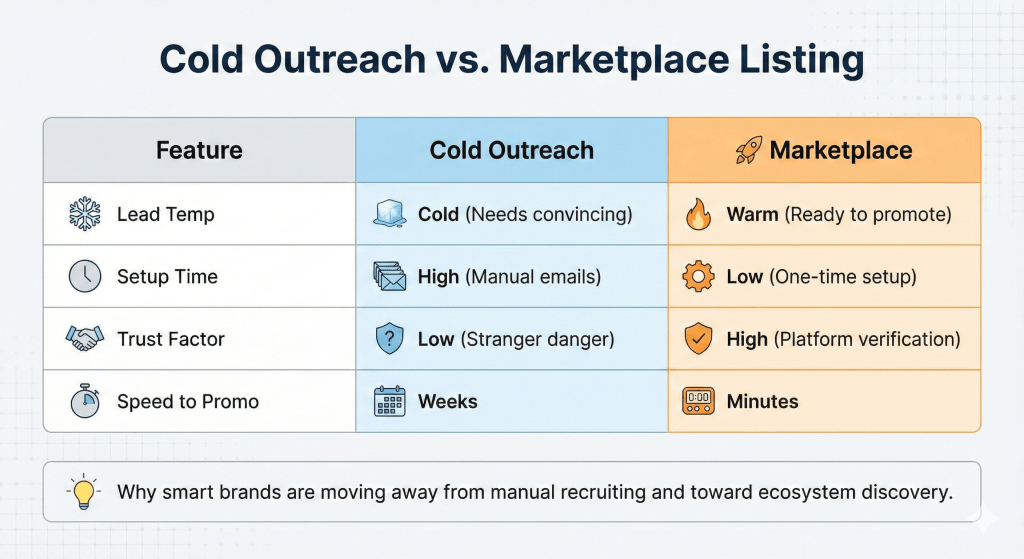
Why This Works Better Than Cold Affiliate Outreach
You can run cold outreach campaigns to find affiliates. But here is why affiliate marketplaces, when used right, tend to outperform cold outreach significantly:
1. Marketplaces Bring You Pre-Warmed Leads
Cold outreach is time-consuming and hit-or-miss. Most people will ignore you, or you will spend hours writing custom DMs that lead nowhere.
In contrast, marketplaces send you affiliates who have opted in. They searched, found your listing, read your offer, and chose to join. They already believe your product is worth sharing. You skip the hardest part—convincing them to care.
2. There’s Less Back-and-Forth
In a cold approach, even if someone replies, the next 7–10 days are usually full of administrative headaches:
- Sending program details.
- Answering “how do I promote you?”
- Negotiating commissions.
- Providing logos and links.
Marketplaces compress this entire workflow into one click. The affiliate browses $\rightarrow$ applies $\rightarrow$ gets auto-approved $\rightarrow$ starts promoting with built-in tracking and materials.
3. Cold Outreach = You’re the Seller. Marketplace = They Come Shopping.
This is a massive positioning advantage.
- When you chase affiliates, you are in seller mode, trying to convince them to give you their time.
- When they discover you through a curated marketplace, they see you as a valuable offer worth applying for.
You have leverage. That subtle difference often leads to better affiliate engagement, longer relationships, and better promotional effort.
Final Thoughts: Discovery-Led Growth Is the New Meta
Traditional affiliate marketing used to be about pitching, recruiting, chasing, and hoping. That model still works—but it is slow, manual, and getting more expensive.
Today, the top-performing brands aren’t doing more outreach. They are getting discovered.
They have built systems where:
- Affiliates come to them through targeted marketplaces.
- Listings convert because they are built like landing pages.
- The right creators find them, resonate with the offer, and start promoting immediately.
- Results snowball—not from hustle, but from visibility.
Affiliate marketplaces like Referral Rocket are powering this shift. They don’t just “list your program”—they plug you into an ecosystem where aligned, ready-to-promote creators actively browse for what’s next.
If you are serious about scaling referrals, this is the model to bet on. Not because it is trendier, but because it is simply more efficient.
Build a great product. Create a compelling listing. Let the right people find you. That is how discovery-led affiliate growth compounds.